Corps of Signals 100th Anniversary
1911 - 2011

Photographs and Report on 14th Reunion at Jablapur: 13- 15 Feb 2011

Showing posts with label WWII. Show all posts

Thursday, 28 July 2011

Act of Remembrance: Indian Signals WWII

Remembering Signalmen who served in Imphal, Kohima, Chindits and Burma War
On Sunday those members who were able travelled by car to the National Memorial Arboretum to attend the 1100am Act of Remembrance. At the end Lt Col Pat Soward told the congregation about the ceremony to follow and invited those not in our party to join us if they wished. He explained the
significance of the day, 65 years almost to the day (2 Sep 45) since the signing of the ‘Instrument of Surrender’ aboard the USS Missouri in Tokyo Bay which formally ended the Second World War.
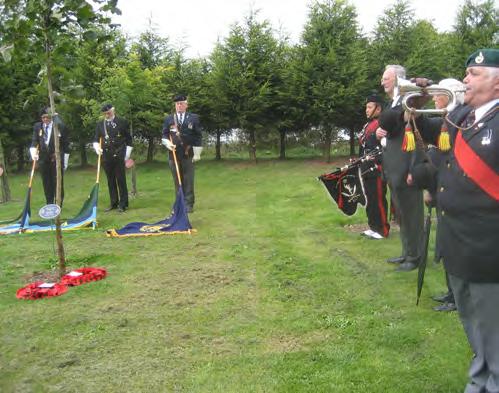
Led by L/Cpl Samir Rai, a piper from 22 Sig Regt, standard bearers carrying the AFSA, Indian Signals Association and Birmingham Branch standards processed to the Far East Air Force Grove where Rev Jim McManus, Chaplain to the AFSA, blessed a tree and dedicated it to all those who had served in 19 (Air Formation) Sig Regt. It appeared that most of those in the chapel had taken up the offer and a goodly number followed to watch. A wreath was laid by Mr Charles Little MBE, who had served in India and Burma with the Regt and after the Exhortation a bugler signalled a silence.
The procession then continued to the Far East area to the tree ‘Planted for all ranks, Royal Signals and Indian Signals, lost in Burma in WW2’ where a new plaque had been installed. The tree was re-dedicated and wreaths laid by Maj Tom Bewsey OBE, chairman of the now disbanded Indian Signals Association, and Lt Col Pat Soward, on behalf of Lt Col Robin Painter in memory of his comrades in the Chindits and at the siege of Imphal who
didn’t return.
After the Exhortation and Kohima Inscription the bugler signalled a further silence after which the parade dismissed. The Indian Signals Association Standard was carried by Mr George Hedge for its last outing before being laid up in the Blandford Garrison Church. George’s father had served in Burma in WW2 and George proudly wore his Burma Star and other medals.
Extracted from: The Wire of Royal Signals

Monday, 25 April 2011

History of the Royal Corps of Signals

Courtesy: Royal Corps of Signals
CAPTAIN MONTAGUE LAMBERT RE
He was the first Commander of 'C' Telegraph Troop, Royal Engineers which was formed in 1870.
The first communication device the heliographs were mainly made in India. The heliograph was used extensively during the various campaigns on the North West Frontier of India and continued in an active service role during World War 1 and even in the desert campaign of World War 2. The next major set forward in military communications was the invention of the telephone in 1876 and its introduction into military service.
Formation of The Royal Corps of Signals
The first official agreement to form a separate Signal Corps was made in 1918, before the end of World War One. Due to various policy delays, the formation of the 'Corps' was delayed until 1920.
A Royal Warrant was signed by the Secretary of State for War, the Rt. Hon Winston S Churchill, who gave the Sovereign's approval for the formation of a 'Corps of Signals' on 28th June 1920. Six weeks later, His Majesty the King conferred the title 'Royal Corps of Signals'.
Campaigns After Formation
During the 1920s and 1930s, the Corps increased its strength and had personnel serving in overseas stations such as Shanghai, Hong Kong, Singapore, Ceylon, Egypt, Jamaica and many other 'out-posts of the Empire'.
The largest portion of the Corps was overseas, one third being concentrated in India. Throughout World War Two, members of the Corps served in every theatre of war and, at the end, the Corps had a serving strength of 8,518 officers and 142,472 soldiers. Indian Signal Corps strength was 2,830 officers and 47490 soldiers.
In the immediate post-war period, the Corps played a full and active part in numerous campaigns including: Palestine (1945-1948); the long campaign. in Malaya (1949-1960); the Korean War (1950-1953); ; the Suez Canal Zone (1956); the various operations in Cyprus, Borneo, Aden, the Arabian Peninsula, Kenya and Belize.
Throughout this time, until the end of the Cold War, the main body of the Corps was deployed with the British Army of the Rhine confronting the former Communist Block forces, providing the British Forces' contribution to NATO with its communications infrastructure.

Sunday, 20 February 2011

Commemoration Ceremony- 15 Feb 2011

Corps of Signals Fourteenth Reunion and Centenary Celebrations, 1 STC Jabalpur 15th Feb 2011 Pollard Arena
Commemoration Ceremony


100 Glorious Years
On this day in 1911, the 31st and 32nd Div Sig Companies of Sappers and Miners, the first Signal units were raised at Fatehegarh. Lt Gen SH Powell, Royal Engineers, was the founder and first head of the Indian Signal Service, which subsequently became Indian Signal Corps. The 33rd and 34th Div Sig Companies were raised at Ahmednagar and 41 Wireless company at Roorkee on 01 Mar 1911.
An innovation was raising of Women's Auxiliary Corps (Indian) in 1943, consisting of Europeans, Eurasians and Indians in 1942 and were employed during WW II as cipher and switchboard operators.
When Lord Mountbatten decided to advance the date of Independence the plans to Indianise the Armed Forces were planned. SO In C Brig CHI Akehurst continued in the appointment till March 1954.
After Independence there were few changes in the organisation of Signals till after the 1962 conflict with China. Major expansion of the Corps took place subsequently and in the Centenary year it is poised to take on greater challenges as the Army migrates to a fully automated digital battle space.

Note: Allow pop ups on this page. Click image for slideshow navigation. Double click for enlarged photographs.
Photographs: Courtesy 1 STC