Army led by deer or lion?
by Ajai Shukla Business Standard, 17th Apr 12
On Sunday the army chief, General V K Singh, raised an intriguing question while talking to schoolchildren in Jaipur. “An army of deer led by a lion is to be feared more than [an] army of lions led by a deer,” said the general.
My first thought as I mulled over this profundity was: can a deer that has served all his life in an army full of deer suddenly transform into a lion at the top? Alternatively, could a lion serving in an army full of deer be promoted somehow to the top slot?
Common sense would rule out both eventualities. An army full of deer would only promote a deer to the top, just as an army of lions would always have a lion in command. But the Indian Army presents a paradoxical third alternative. The numerous lions in this excellent army serve up to a certain rank. Then, around the time they become colonels or brigadiers, something strange happens: the lions start turning into deer!
The General V K Singh affair illuminates the generals in a harsh and unforgiving light. The generals emerge as riven with infighting; they undermine meritocracy by promoting loyalists; and, perhaps most worryingly, they compromise the army’s readiness for war by meekly acquiescing in crippling shortfalls of equipment and ammunition.
Over a drink, ask any junior or mid-ranking officer, and you will find disillusionment with senior commanders and with a working environment that rewards the safe and predictable rather than the bold and unexpected. Recent controversies have exacerbated murmurs that generals only think about themselves. Talk to the generals, on the other hand, and they express disappointment over the “poor quality” of young officers. There is a clear disconnect between the two ends of the rank pyramid, between the lions and the deer.
This observation is fraught with personal danger, since my army batch-mates have just been evaluated, and many of them cleared, for promotion to major general! Knowing these gentlemen as intimately as a course-mate, comrade and friend of many years does, I acknowledge with some satisfaction that the army has homed in on the high achievers. But identifying good lions is of little use if they begin turning into deer.
At a time when many soldiers – serving and retired – bitterly regard themselves as under attack from the defence ministry, the media, and even the judiciary, it is time for India’s finest and most resilient institution to look within rather than without. What are the systemic flaws in the army structure that disempowers its leaders and binds them in mental shackles?
The first is a growing culture of conformity: an intolerance of alternative viewpoints that is the natural attribute of under-confident commanders. This causes the boss’ viewpoint (itself springing from what he thinks his boss’ viewpoint might be) to become the viewpoint of everyone down the chain — effectively killing any prospect of internal reform. The system cannot be challenged from within, since any discussion about alternative leadership models presupposes that the existing model might be less than perfect.
It is nobody’s case that the army should encourage dissent; no military does. But great armies tolerate, and actively encourage, non-conformism. This is essential, not just for operational innovativeness that would keep the enemy guessing in war, but also for throwing up essential bottom-up challenges to the status quo. Totalitarian Conformism, as today’s army leadership style might be termed, reduces the landscape of professional and personal creativity to a dull wasteland where the fabled “dashing young officer” is marked not by flashes of innovative genius but by his quickness in agreeing with the boss.
Young officers allow themselves to be bound by these shackles because of the army’s insularity. Segregated from the world outside, and with little realisation of their actual worth, junior officers are reluctant to buck the system. Given the conviction that promotion is the only measure of success, they toe the line rather than risk professional hara-kiri by setting out to change the system. Their outlook can only change with exposure. Sending out junior officers on secondments and deputations – with academic institutions; successful government enterprises; media organisations; the police forces – will enrich the military’s bloodline with external leadership and decision-making cultures. It will also provide officers with the confidence that is required to challenge the status quo and to create a bottom-up dynamic that forces the generals to respond like lions rather than continue like deer.
Will the generals permit such a change? Most probably not since empowering junior officers and encouraging non-conformism are threatening prospects. Good reasons are ready at hand to shoot down such “unworkable” and “impractical” ideas: a shortage of officers; inter-se seniority issues during secondment; and so on. It would, therefore, be necessary for the government to intervene. We’re waiting for Godot.
Tailpiece
The phrase “lions led by donkeys” was used by the Germans to describe the British army during World War I. It encapsulated their impression of incompetent generals letting down the brave and dedicated British soldier.
Click here for the original post

Showing posts with label 14th Reunion. Show all posts
Showing posts with label 14th Reunion. Show all posts
Wednesday, 18 April 2012

Thursday, 12 May 2011
Royal Signals hands over to Corps of Signals Indian Army- 15 Aug 1947
Sunset on The Raj
The end of colonialism in india. Lord Louis Mountbatten under the command of reigning monarch George VI- 15 Aug 1947
Royal Signals were based in Quetta and Jubbulpur India 1938-1948
GHQ Signals Regiment (Army HQ Signal Regiment)
GHQ Signals Regiment stationed in New Delhi played a vital role in communications during the period 1946-1948. The regiment was responsible for supplying information to both the Indian and British governments of all the upheavals that took place at that time. Information was gathered from all over India, and this passed to the world media via government sources. Names of Signal Officers who were involved with the ceremonies that took place on August 15th 1947 will be found in the Corps History.
The duties were taken over by Indian Army towards the end of 1947. Bombay signals, southern command signals (known as Bombay Signals) stationed at Colaba in Bombay. Commnding Officer Major Higgins (served as corporal under Capt H Sunderland).
Signals Training Centre - STC(1) Mhow. Major RH Farlow, April 1947.
Signals Squadron Deolali, 14070401 Sgmn Cutler L, British Brigade Group, Signals Squadron Deolali, India - Command, 28th February 1948 returned.
Waziristan Signals HQ Dera Ismail Khan, 14695948ws sgt Banbde signal sec, Razmak signal sec, 1945 to Aug 1947.
Communications Security School Attached to the Signals Training Centre
MHOW, India. Major Prince CJ Capt Denton. Lt Williams EJ Instructors included: Sgt Symons JR, CSM Stansford DJ, Sgt Rattenbury S, Sgt Knighton JK, Cpl Perkins ML.
This team were responsible for training members of The Communications Security personnel from units throughout the British Army in India Under the badge of the Royal Signals.
The cipher was high grade to Top Secret standard and was vital for the army units all over India, especially during the years 1945-48. Thanks to John Beal for this entry.
2nd Indian Airborne Divisional Signal Regiment I was a member of the South Staffordshire Regiment, but was attached to 2nd Indian Airborne Division Signal Regiment after being converted to Ciphers in 1946. The Regiment was, at that time, stationed in Clifton which was part of Karachi, and the until was under the command of Lt.Col David Horsfield. Later that year the unit relocated to Malir, some 10 miles from Karachi, and occupied what was previously an American Army camp. Lt Col Horsfield was recalled to Europe and the unit was then commanded by Major, and later by Lt Col DG Jones.
Towards the spring of 1947 the unit relocated yet again to Quetta, and it was here that it saw the Independence of both India and Pakistan in the August of that year. 2nd Indian Airborne Divisional Signal Regiment was designated an 'Indian Army Unit' and moved very quickly from Quetta (Pakistan) into India. The British Army content, which then comprised approx 40 other ranks and 5 officers detached themselves from the 'Indian' unit, and under my command moved to the transit camp in Karachi from where we were repatriated to the UK in November/ December 1947 on the troopship 'Empire Trooper'. Thanks to Norman Logan for this entry.
Ceylon Signal's Squadron, Colombo, Ceylon. Echelon Barracks, Colombo. Major J Badcock, Major PAM Tighe.
Courtesy: Sunset of The Raj
The end of colonialism in india. Lord Louis Mountbatten under the command of reigning monarch George VI- 15 Aug 1947
Royal Signals were based in Quetta and Jubbulpur India 1938-1948
GHQ Signals Regiment (Army HQ Signal Regiment)
GHQ Signals Regiment stationed in New Delhi played a vital role in communications during the period 1946-1948. The regiment was responsible for supplying information to both the Indian and British governments of all the upheavals that took place at that time. Information was gathered from all over India, and this passed to the world media via government sources. Names of Signal Officers who were involved with the ceremonies that took place on August 15th 1947 will be found in the Corps History.
The duties were taken over by Indian Army towards the end of 1947. Bombay signals, southern command signals (known as Bombay Signals) stationed at Colaba in Bombay. Commnding Officer Major Higgins (served as corporal under Capt H Sunderland).
Signals Training Centre - STC(1) Mhow. Major RH Farlow, April 1947.
Signals Squadron Deolali, 14070401 Sgmn Cutler L, British Brigade Group, Signals Squadron Deolali, India - Command, 28th February 1948 returned.
Waziristan Signals HQ Dera Ismail Khan, 14695948ws sgt Banbde signal sec, Razmak signal sec, 1945 to Aug 1947.
Communications Security School Attached to the Signals Training Centre
MHOW, India. Major Prince CJ Capt Denton. Lt Williams EJ Instructors included: Sgt Symons JR, CSM Stansford DJ, Sgt Rattenbury S, Sgt Knighton JK, Cpl Perkins ML.
This team were responsible for training members of The Communications Security personnel from units throughout the British Army in India Under the badge of the Royal Signals.
The cipher was high grade to Top Secret standard and was vital for the army units all over India, especially during the years 1945-48. Thanks to John Beal for this entry.
2nd Indian Airborne Divisional Signal Regiment I was a member of the South Staffordshire Regiment, but was attached to 2nd Indian Airborne Division Signal Regiment after being converted to Ciphers in 1946. The Regiment was, at that time, stationed in Clifton which was part of Karachi, and the until was under the command of Lt.Col David Horsfield. Later that year the unit relocated to Malir, some 10 miles from Karachi, and occupied what was previously an American Army camp. Lt Col Horsfield was recalled to Europe and the unit was then commanded by Major, and later by Lt Col DG Jones.
Towards the spring of 1947 the unit relocated yet again to Quetta, and it was here that it saw the Independence of both India and Pakistan in the August of that year. 2nd Indian Airborne Divisional Signal Regiment was designated an 'Indian Army Unit' and moved very quickly from Quetta (Pakistan) into India. The British Army content, which then comprised approx 40 other ranks and 5 officers detached themselves from the 'Indian' unit, and under my command moved to the transit camp in Karachi from where we were repatriated to the UK in November/ December 1947 on the troopship 'Empire Trooper'. Thanks to Norman Logan for this entry.
Ceylon Signal's Squadron, Colombo, Ceylon. Echelon Barracks, Colombo. Major J Badcock, Major PAM Tighe.
Courtesy: Sunset of The Raj
Thursday, 21 April 2011
Coffee Table Book
The Defence Minister, Shri A. K. Antony unveiled the Corps of Signals coffee table book Feb 17, 2011
 The Defence Minister, Shri A. K. Antony unveiled the Corps of Signals coffee table book on the occasion of Corps of Signals Centenary celebrations, in New Delhi on February 17, 2011.
The Minister of State for Defence, Dr. M.M. Pallam Raju, the Minister of State for Communications and Information Technology and Home Affairs, Shri Gurdas Kamat, the Chief of Army Staff, General V.K. Singh, the Deputy Chief of Army Staff, Lt. Gen. V.S. Tonk and the Signal Officer-in-Chief, Lt. Gen. P Mohapatra are also seen.
What is a Coffee Table Book?
A coffee table book is a hardcover book that is intended to sit on a coffee table or similar surface in an area where guests sit and are entertained, thus inspiring conversation or alleviating boredom. They tend to be oversized and of heavy construction, since there is no pressing need for portability. Subject matter is generally confined to non-fiction, and is usually visually-oriented. Pages consist mainly of photographs and illustrations, accompanied by captions and small blocks of text, as opposed to long prose. Since they are aimed at anyone who might pick the book up for a light read, the analysis inside is often more basic and with less jargon than other books on the subject. Because of this, the term "coffee table book" can be used pejoratively to indicate a superficial approach to the subject.
History
David R Brower is sometimes credited with inventing the "modern coffee table book". While serving as executive director of the Sierra Club, he had the idea for a series of books that combined nature photography and writings on nature, with, as he put it, "a page size big enough to carry a given image’s dynamic. The eye must be required to move about within the boundaries of the image, not encompass it all in one glance." The first such book, "This is the American Earth", with photographs by Ansel Adams and others and text by Nancy Newhall, was published in 1960; the series became known as the "Exhibit Format" series, with 20 titles eventually published.

The Minister of State for Defence, Dr. M.M. Pallam Raju, the Minister of State for Communications and Information Technology and Home Affairs, Shri Gurdas Kamat, the Chief of Army Staff, General V.K. Singh, the Deputy Chief of Army Staff, Lt. Gen. V.S. Tonk and the Signal Officer-in-Chief, Lt. Gen. P Mohapatra are also seen.
What is a Coffee Table Book?
A coffee table book is a hardcover book that is intended to sit on a coffee table or similar surface in an area where guests sit and are entertained, thus inspiring conversation or alleviating boredom. They tend to be oversized and of heavy construction, since there is no pressing need for portability. Subject matter is generally confined to non-fiction, and is usually visually-oriented. Pages consist mainly of photographs and illustrations, accompanied by captions and small blocks of text, as opposed to long prose. Since they are aimed at anyone who might pick the book up for a light read, the analysis inside is often more basic and with less jargon than other books on the subject. Because of this, the term "coffee table book" can be used pejoratively to indicate a superficial approach to the subject.
History
David R Brower is sometimes credited with inventing the "modern coffee table book". While serving as executive director of the Sierra Club, he had the idea for a series of books that combined nature photography and writings on nature, with, as he put it, "a page size big enough to carry a given image’s dynamic. The eye must be required to move about within the boundaries of the image, not encompass it all in one glance." The first such book, "This is the American Earth", with photographs by Ansel Adams and others and text by Nancy Newhall, was published in 1960; the series became known as the "Exhibit Format" series, with 20 titles eventually published.
Sunday, 17 April 2011
Corps of Signals History- Challenges

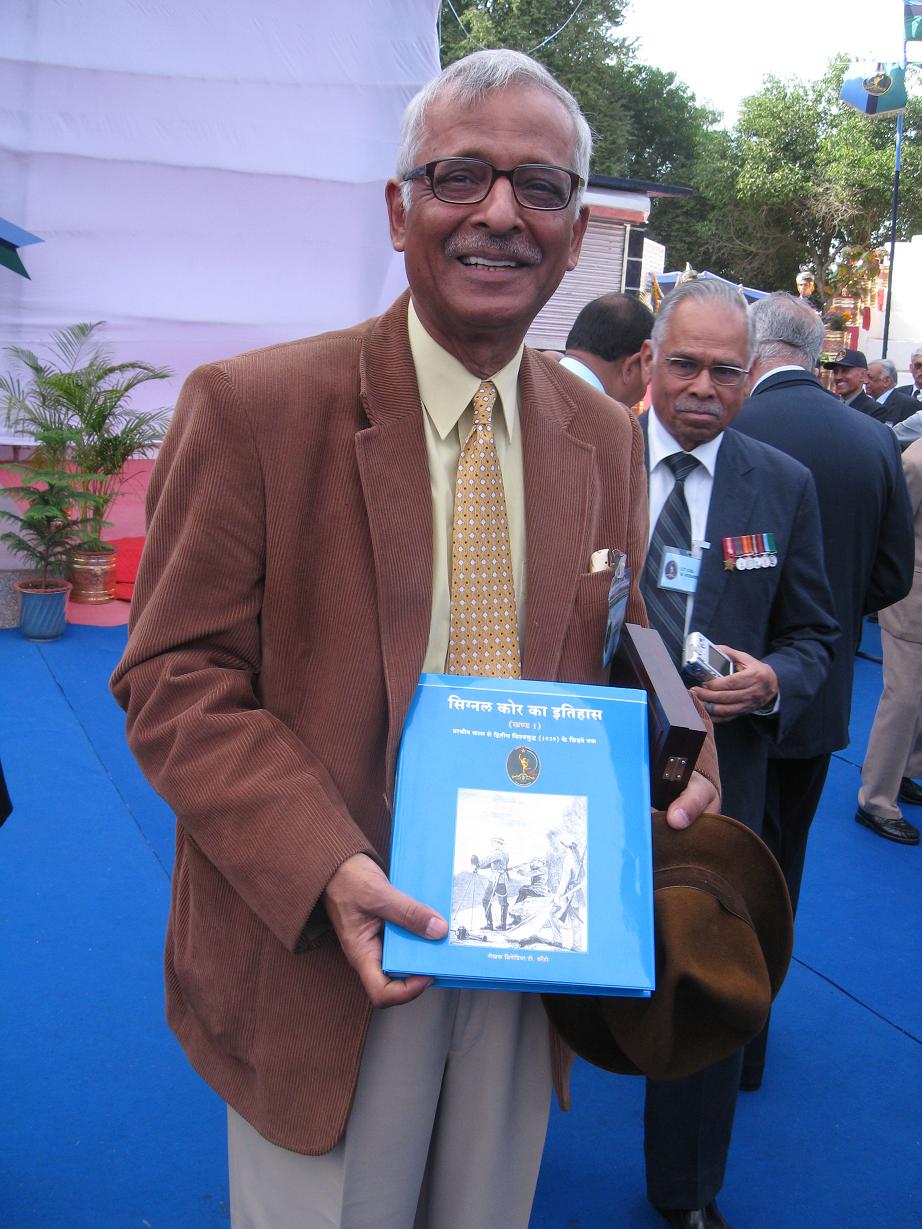
Though no history of the Corps was published during the period 1947-72, most of the work including the writing of the script of Volume I covering the period 1911-39 was completed during this time. The story of the ups and downs connected with the publication of the book has been covered in ‘History of the History’ which forms Appendix 1 of Volume II. However, the deliberations of the Corps Committee concerning the history of the Corps and other subjects within the purview of the Corps History Committee which are relatively unknown will be covered here.
The Corps Committee, in its very first meeting held in September 1946, ‘agreed that it was most desirable that the history of the Indian Signal Corps should be compiled’. However, nothing much seems to have been done during the next few years except a visit to the Historical Section in Simla by the Deputy Director Signals in early 1953 and the initiation of a case for a lieutenant colonel to write the Corps history. The lieutenant colonel and his staff were sanctioned, but due to acute shortage of officers in the Corps, no officer could be provided for this task. 69
Fortunately, Colonel T Barreto was posted as Deputy Director of Signals from 1953-56. Without any mandate from the Corps Committee, he had begun collecting material in 1951, when he was at the Staff College, and continued his efforts during his tenure at Delhi. This naturally came to the knowledge of Brigadier Akehurst and Brigadier Iyappa, who succeeded him in 1954. In 1957, the Corps Committee agreed that the compilation of the history of the Corps is a long outstanding necessity. They appreciated the effort already put in by Brigadier Barreto and requested him to accept the responsibility to complete the Corps history, sanctioning a sum of Rs. 1000/- for expenses.
By this time Brigadier Barreto had moved to Poona as CSO Southern Command. He was nominated Chairman of the Corps History Committee, an appointment he held until his retirement in 1965. During his tenures at Poona (1956-60); Simla (1960-63) and Mhow (1963-65), he continued to work assiduously on the project. He presented the first report of the Corps History Committee during the 11th Corps Committee Meeting in 1958. Thereafter, he presented progress reports in every meeting of the Corps Committee up to 1965, which was the last meeting he attended. During this meeting, he informed the Committee that the manuscript of Volume I of the History of the Indian Signal Corps was almost ready. In the absence of the Chairman, Lieutenant General Iyappa, the meeting was chaired by the Co-Chairman, Major General Batra, who stated that he had discussed the matter with the Senior Colonel Commandant. As the printing of the Volume would require last minute coordination with the printers, it would be printed in India. It had been decided that the services of Lieutenant Colonel Proudfoot be engaged for technical vetting of the manuscript and processing till its final publication.
The decision to engage Lieutenant Colonel Proudfoot could not have been taken kindly by Brigadier Barreto. It indicated a lack of confidence in his abilities which was totally unjustified. That this was done without consulting him was even more galling. Due to various reasons, he put in his papers and retired prematurely in June 1965, when he was the Commandant of the School of Signals. Before he retired, he was asked to hand over the manuscript and all the material collected by him painstakingly over the previous 10-15 years.
Though the manuscript had been completed by Brigadier Barreto before he retired, the project went into limbo after his departure, with the Corps not being able to find a suitable replacement to head the Corps History Committee. The next meeting of the Corps Committee records:
Since the retirement of Brig T BARRETO a new Chairman of the Corps History Committee has not yet been appointed in his place. No report has, therefore, been prepared for discussion. CSO Central Command stated that the present system of collecting data for the compilation of Corps History entailed delay and therefore the system should be revised and the responsibility entrusted to a training establishment to whom copies of war diaries and other materials of historical value to the Corps should be made available. He also stated that it may be advantageous to employ a retired officer who may progressively compile the History and keep it up-to-date.
In 1967 the Corps Committee was informed that the only nomination received so far for ‘writing’ the Corps history was that of Lieutenant Colonel A Asirvadam of the School of Signals. Brigadier KD Bhasin stated that he had informally contacted Brigadier Barreto who had declined to undertake the task. The Chairman, Lieutenant General Iyappa, asked the SO-in-C, Major General ID Verma to discuss this issue with Brigadier Barreto during his next visit to Jabalpur. Meanwhile, all the material still held with Brigadier Barreto was to be taken over from him and properly compiled to facilitate further work. Major GY Sowani of 1 STC was to carry out processing of Volume I and start writing the draft for Volume II. The draft written Major Sowani was to be passed on to Colonel SN Mehta for vetting and finalisation.
For the next four years literally nothing was done with regard to the Corps history. The subject was also not discussed by the Corps Committee during the meetings held in 1968, 1969 and 1970. In 1971 Commandant 1 STC placed before the Corps Committee the list of items which had been collected from Brigadier Barreto and kept in the Corps Museum. The Chairman, Lieutenant General Iyappa then suggested that it is time we take some concrete action to publish the Corps history. CSO Southern Command stated that Lieutenant Colonel GY Sowani had volunteered to do the work. (This had been approved by the Committee four years earlier). Initially he should be moved to Jabalpur on temporary duty to make an assessment of the volume of work involved and later he may be posted to Jabalpur if necessary.
In the event, after Colonel GY Sowani also begged off, various other writers approached, including Lieutenant Colonel CL Proudfoot, Colonel Pyara Lal Colonel V Anantahraman, Major KS Kapur Brigadier KD Bharagava and Lieutenant Colonel JC Dhamija. Volume I of the Corps History was finally published in 1975, ten years later after its completion by Brigadier Barreto. The book was a verbatim reproduction of the original draft except for a change in the title. The preface written by Brigadier Barreto was omitted and so was his name as the author. One can only wonder at the lackadaisical manner in which the Corps history project was addressed by the Corps Committee and the callous manner in which it treated one of its most distinguished members. Brigadier Barreto had been the longest serving member of the Corps Committee, except for General Iyappa. 6/7/2010
Maj Gen VK Singh (Retd)
Comment: Wonderful insight into the ordeals and challenges confronted in getting the Corps History Published. Brig Barreto and Maj Gen VK Singh are the true time keepers of Corps of Signals for perpetuity.
Wednesday, 13 April 2011
Corps of Signals War Memorial
Corps of Signals Centenary Celebrations and 14th Reunion 1 STC Jabalpur


To honour the sacred memory of those brave brethren who laid down their lives during World War I and II in service of the Corps and the country, a War Memorial was erected on the Parade Ground of 1 Military Training Regiment of 1 Signal Training Centre, Jabalpur. The Memorial was unveiled at a solemn ceremony on 13 February 1961 during the Golden Jubilee Reunion. This Memorial is a 305 cms high wall made of Katni stone and a matching base. The column mounts the original Corps Badge (Emblem) of the Indian Signal Corps in brass and Dedicatory Plaque with the inscription 'IN MEMORY OF THE THOSE WHO GAVE THEIR LIVES IN THE SERVICE OF THE COUNTRY'.
As a matter of Corps custom, only white roses are grown and floral tributes of white roses only are paid. In Feb 1970, the current Emblem of the Corps was mounted beneath the old one. This memorial adorns the Parade Ground of 1 Military Training Regiment in Anderson Lines that has, since 1920, been watered by the sweat of the recruits who joined the Corps. It is on this Drill Square, in the shadow of this symbol of supreme sacrifice that they pledge their loyalty to the service and the nation on entering the Corps. There is no better backdrop than that of this parade ground to attest the recruits on their entry into the Corps as trained soldiers. The Regimental Attestation Parade has therefore, become an important ceremony, which is held in the shadow of the War memorial. For all these ceremonies, the Roll of Honour is brought ceremoniously and kept at the foot of the War Memorial to enliven the memory of our brethren who have given their lives in the service of the Corps and the Country.
Corps of signals War Memorial


To honour the sacred memory of those brave brethren who laid down their lives during World War I and II in service of the Corps and the country, a War Memorial was erected on the Parade Ground of 1 Military Training Regiment of 1 Signal Training Centre, Jabalpur. The Memorial was unveiled at a solemn ceremony on 13 February 1961 during the Golden Jubilee Reunion. This Memorial is a 305 cms high wall made of Katni stone and a matching base. The column mounts the original Corps Badge (Emblem) of the Indian Signal Corps in brass and Dedicatory Plaque with the inscription 'IN MEMORY OF THE THOSE WHO GAVE THEIR LIVES IN THE SERVICE OF THE COUNTRY'.
As a matter of Corps custom, only white roses are grown and floral tributes of white roses only are paid. In Feb 1970, the current Emblem of the Corps was mounted beneath the old one. This memorial adorns the Parade Ground of 1 Military Training Regiment in Anderson Lines that has, since 1920, been watered by the sweat of the recruits who joined the Corps. It is on this Drill Square, in the shadow of this symbol of supreme sacrifice that they pledge their loyalty to the service and the nation on entering the Corps. There is no better backdrop than that of this parade ground to attest the recruits on their entry into the Corps as trained soldiers. The Regimental Attestation Parade has therefore, become an important ceremony, which is held in the shadow of the War memorial. For all these ceremonies, the Roll of Honour is brought ceremoniously and kept at the foot of the War Memorial to enliven the memory of our brethren who have given their lives in the service of the Corps and the Country.
Corps of signals War Memorial
Tuesday, 12 April 2011
Souvenirs and Memorabilia
14th Reunion at 1STC Jabalpur
 Similar to souvenirs, memorabilia (Latin for memorable things, plural of memorābile) are objects treasured for their memories; however, unlike souvenirs, memorabilia are valued for a connection to an event. Examples include Reunions, sporting events, historical events, culture and entertainment. Such items include playing cards, carry bags, publicity photographs, posters, caps, cups, clocks and such other collectables.
14th Reunion had an array of such items:
1. Corps tie
2. Corps scarf
3. Reunion folder with brochures and posters
4. Wall clocks and wrist watches
5. Hand Bag
6. Cups
7. Ladies Handkerchief
8. Caps

14th Reunion had an array of such items:
1. Corps tie
2. Corps scarf
3. Reunion folder with brochures and posters
4. Wall clocks and wrist watches
5. Hand Bag
6. Cups
7. Ladies Handkerchief
8. Caps
Monday, 11 April 2011
Autographed India Post Stamp and Cover
Centenary Celebration of Corps of Signals- India Post releases Postage Stamp


Dear Sir,
I am sending the photographs of signals postage stamp issued during centenary celebrations and veteran signallers has signed on this issue of stamps. Please circulate through your “report my signal”.
With warm regards
Col S C Ghose (Retd)


Dear Sir,
I am sending the photographs of signals postage stamp issued during centenary celebrations and veteran signallers has signed on this issue of stamps. Please circulate through your “report my signal”.
With warm regards
Col S C Ghose (Retd)
Friday, 1 April 2011
The Modernisation Process and the Poineers
Supreme Commander Inaugurating 100th Anniversary
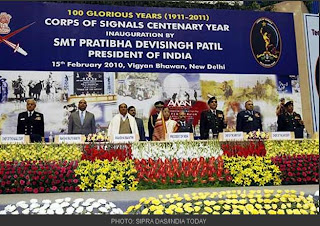 The Modernisation Process
The Corps of Signals is well poised to exploit the state-of-art modern communication techniques for meeting the requirements of the Indian Army of the 21st Century. The ASTROIDS (Army Strategic Operational Information Dissemination System) and the DCN (Defence Communication Network) are other networks which have been visualised to cover communication requirements of all three services at the strategic level. Some of the areas where the Corps is already in the process of exploiting are the cellular radios - in both GSM (Global Satellite for Mobile Communications) & CDMA (Code Division Multiple Access) modes, WLL (Wireless Local Loop), OFC (Optical Fibre Cable), mobile trunk radios, mobile satellite systems, etc. Advanced data transmission methods such as SDH (Synchronous Digital Hierarchy) and PDH (Plesiochronous Digital Hierarchy) are also being used.
Personnel of the Corps are regularly sent abroad to expand their knowledge in numerous areas of telecommunications, information technology and electronic warfare including attending conferences such as the International Telecommunication Union (ITU) to keep abreast with the latest in communications technology. The Corps also fielded communication task forces for the United Nations Interim Force in Lebanon and the United Nations Peace Keeping Force in Sierra Leone. Signals personnel have also attended the Indian Army's training teams at Botswana and Mauritius.
Poineers in computerisation
To start the computerisation process, a middle level officer of the Corps of Signals, Maj OA Pereira was deputed to undergo a one year computer course at the statistical institute, Calcutta. On his return, the nucleus of a computer cell was formed at the AHQ. Around the same time, a training facility was organised by the Government at Delhi based on a Honeywell mainframe computer system. The scope of such training was, however, limited to fundamentals of computer technology and programming in COBOL with an exposure of FORTRAN. Simultaneously, officers were also sent to US Army School at Fort Monmonth, New Jersey for regular computer courses. Notable amongst these trainees were Lt Col MS Sodhi and Lt Col Harbhajan Singh, later both of them rose to the rank of Lt Gen's as SO in C. Prominent amongst the early computer poineers were Lt Col (Maj Gen) BS Paintal and Maj (Brig) VM Sundaram. They played a leading role in educating and spreading compuer awareness. Subsequently Maj Gen Gopal Das and Maj Gen Ganga Prasad made significant contribution for the planning and organisation of computer education and training. Brig SVS Chowdhry was closely associated with the computer education activity, first as a faculty member at MCTE, Mhow and later on in the planning and coordination of computer training during his two tenures at the Army Headquarters.

The Corps of Signals is well poised to exploit the state-of-art modern communication techniques for meeting the requirements of the Indian Army of the 21st Century. The ASTROIDS (Army Strategic Operational Information Dissemination System) and the DCN (Defence Communication Network) are other networks which have been visualised to cover communication requirements of all three services at the strategic level. Some of the areas where the Corps is already in the process of exploiting are the cellular radios - in both GSM (Global Satellite for Mobile Communications) & CDMA (Code Division Multiple Access) modes, WLL (Wireless Local Loop), OFC (Optical Fibre Cable), mobile trunk radios, mobile satellite systems, etc. Advanced data transmission methods such as SDH (Synchronous Digital Hierarchy) and PDH (Plesiochronous Digital Hierarchy) are also being used.
Personnel of the Corps are regularly sent abroad to expand their knowledge in numerous areas of telecommunications, information technology and electronic warfare including attending conferences such as the International Telecommunication Union (ITU) to keep abreast with the latest in communications technology. The Corps also fielded communication task forces for the United Nations Interim Force in Lebanon and the United Nations Peace Keeping Force in Sierra Leone. Signals personnel have also attended the Indian Army's training teams at Botswana and Mauritius.
Poineers in computerisation
To start the computerisation process, a middle level officer of the Corps of Signals, Maj OA Pereira was deputed to undergo a one year computer course at the statistical institute, Calcutta. On his return, the nucleus of a computer cell was formed at the AHQ. Around the same time, a training facility was organised by the Government at Delhi based on a Honeywell mainframe computer system. The scope of such training was, however, limited to fundamentals of computer technology and programming in COBOL with an exposure of FORTRAN. Simultaneously, officers were also sent to US Army School at Fort Monmonth, New Jersey for regular computer courses. Notable amongst these trainees were Lt Col MS Sodhi and Lt Col Harbhajan Singh, later both of them rose to the rank of Lt Gen's as SO in C. Prominent amongst the early computer poineers were Lt Col (Maj Gen) BS Paintal and Maj (Brig) VM Sundaram. They played a leading role in educating and spreading compuer awareness. Subsequently Maj Gen Gopal Das and Maj Gen Ganga Prasad made significant contribution for the planning and organisation of computer education and training. Brig SVS Chowdhry was closely associated with the computer education activity, first as a faculty member at MCTE, Mhow and later on in the planning and coordination of computer training during his two tenures at the Army Headquarters.
Thursday, 31 March 2011
India Post releases stamp on Corps of Signals

India Post Released New Stamp on Corps of Signals
Wednesday, 30 March 2011
The Indian Army Signal Corps Motorcycle Expedition to Blandford Camp


After a year of planning and last minute route changes, 10 members of the Indian Army Signal Corps Motorcycle Expedition 2010 finally completed their month long 3000 mile journey to Blandford Camp on Friday 17 Sep 10,2010. The team led by Lt Col Vks Tomar which included 2 female officers, Captains Ravinder Kaur and Tashi Thapilyal arrived at RHQ Royal Signals to be greeted by the fanfare trumpeters of the Corps Band and a reception party headed jointly by the SOinC(A), Brig Tim Watts OBE ADC and the Military Attache, Brig Anil Mehta from the Indian High Commission in London. After the team was introduced to the SOinC a special introduction was made to Maj (Retd) Tom Bewsey OBE (93 years of age) the last Chairman of the Indian Army Signal Corps Association. With only 3 members still living it was a particular privilege for the visiting riders that one of the surviving veterans who served in the Indian Army Signal Corps before partition in 1947 could also make the journey to Blandford. The motorcycle expedition was devised as a suitable way in which the Indian Army Signal Corps could reconnect with their heritage and visit the Home of the Royal Corps of Signals to make a small presentation in their Centenary celebration year. The Indian Army Signal Corps will officially reach its 100th birthday on 15 Feb 2011 when the major commemorative events including a reunion will take place at the Signal Training Centre at Jubbulpore. Following their epic journey and the formal arrival and presentation ceremony the riders were entertained to an evening of well deserved relaxation and reminiscing before once again mounting their 250cc Royal Enfield motorcycles in order to watch the White Helmets undertake their last performances for this display season at the Royal Berkshire Show. The expedition members have been on the road for almost a month and after completing a number of wreath laying and other ceremonies in Brighton, London and Camberley will return to India by air on 29 Sep 10, 2010.
THE INDIAN ARMY SIGNAL CORPS MOTORCYCLE EXPEDITION 2010
Related Blog Report
Siver Stride Motorcycle Expedition
Oldest British Officer from Indian Signal Corps
Maj (Retd) Tom Bewsey OBE of Indian Signal Corps, talking on "Operation Overlord". Tom is known to a very large section of the local community where he he has been involved in many activities notably being a founder member of the Sidcup Symphony Orchestra, being a Governor of Harenc School, and three times President of this Society. War time experience in the Royal Corps of Signals led him to a peacetime career in maritime radar and marine engineering. The talk on " Operation Overlord" was a lucid and interesting account of Tom's involvement with the planning of the Royal Signals part in the D Day landing. He showed how extreme secrecy was maintained before the actual invasion. His Signals unit was stationed on the Isle of Wight where they were aware of the possibility of a German Paratroop landing which however did not occur. Occupying high ground on the Isle of Wight gave him a ring side view of "the greatest amphibious operation in history". Although the story of the Normandy landings is well known much of Tom Bewsey's talk was of the part played by Royal Signals in carrying out a meticulously planned deception campaign. This resulted in the retention by the Germans of 12 divisions in the Calais area and a further 12 divisions in Norway. Fictitious military units were set up in Scotland and in the South East of England with dummy tanks and trucks. This deception was planned by Jasper Maskelyne, the grandson of the famous Edwardian Illusionist. Not all the Signals activities involved 20th Century science. Carrier pigeons were used to convey messages from France and one particular bird received the Dickin Medal for Animal Bravery on account of several successful flights.
Tuesday, 22 March 2011
A Centenary of Communications, Courage and Commitment
Commemoration Ceremony held at Manekshaw Centre on 17 February, New Delhi

To mark the culmination of the Centenary Year of Corps of Signals, a Commemoration Ceremony was held at Manekshaw Centre on 17 February in New Delhi. The Chief Guest of the function was Defence Minister A K Antony. Other dignitaries present as Guests of Honour were Minister of State for Defence M M Pallam Raju, Minister of State for Communication and Information Technology Gurudas Kamat and General V K Singh, PVSM, AVSM, YSM, ADC, Chief of Army Staff, Lt Gen P Mohapatra, SO-in-C and Maj Gen RN Chakrabarty, ADGSS. The ceremony was attended by Senior Officers of Ministry of Defence, Ministry of Communication and Information Technology (MoC&IT) and also a large number of serving officers of Integrated HQ of MoD (Army), DRDO and Veteran officers and personnel of the Corps of Signals. During the event a Commemoration Stamp and a Coffee Table Book were released.
The Centenary Year of the Corps was marked by conducting various Ceremonial, Welfare, Sports and Adventure activities pan India. Serving and retired personnel participated in such events with enthusiasm and pride. The 14th Reunion at 1 STC Jabalpur was the Grand Finale which witnessed three days of glamourous, memorable and solemn events.
Individual events of the 14th Reunion can be perused at will from the archive section commencing from 12 Feb 2011 in this Blog. There are over 500 Photographs and 8 Video clips for the viewing pleasure.
Read more Asia Defence News Report- click here
President's Speech- Inaugural Ceremony of Centenary Celebrations of the Corps of Signals

To mark the culmination of the Centenary Year of Corps of Signals, a Commemoration Ceremony was held at Manekshaw Centre on 17 February in New Delhi. The Chief Guest of the function was Defence Minister A K Antony. Other dignitaries present as Guests of Honour were Minister of State for Defence M M Pallam Raju, Minister of State for Communication and Information Technology Gurudas Kamat and General V K Singh, PVSM, AVSM, YSM, ADC, Chief of Army Staff, Lt Gen P Mohapatra, SO-in-C and Maj Gen RN Chakrabarty, ADGSS. The ceremony was attended by Senior Officers of Ministry of Defence, Ministry of Communication and Information Technology (MoC&IT) and also a large number of serving officers of Integrated HQ of MoD (Army), DRDO and Veteran officers and personnel of the Corps of Signals. During the event a Commemoration Stamp and a Coffee Table Book were released.
The Centenary Year of the Corps was marked by conducting various Ceremonial, Welfare, Sports and Adventure activities pan India. Serving and retired personnel participated in such events with enthusiasm and pride. The 14th Reunion at 1 STC Jabalpur was the Grand Finale which witnessed three days of glamourous, memorable and solemn events.
Individual events of the 14th Reunion can be perused at will from the archive section commencing from 12 Feb 2011 in this Blog. There are over 500 Photographs and 8 Video clips for the viewing pleasure.
Read more Asia Defence News Report- click here
President's Speech- Inaugural Ceremony of Centenary Celebrations of the Corps of Signals
Saturday, 19 March 2011
Corps of Signals Museum
1 STC Jabalpur
Dear Signallers,
If you haven't lately been to the Corps museum at Jabalpur, just join me and Laxi, for a trip inside.
Thanks
Brig Narinder Dhand (Veteran)
Dear Signallers,
If you haven't lately been to the Corps museum at Jabalpur, just join me and Laxi, for a trip inside.
Thanks
Brig Narinder Dhand (Veteran)
Friday, 18 March 2011
First Indian Signal Officer in Chief
Corps of Signals 1911- 2011, 100th Anniversary

Sitting L to R: Lt Col DC Saker, Brig AC Iyappa MBE, Maj SN Atal
Standing L to R: 2/Lt Satish Chandra, Lt RA Bhola, Lt KL Suri
At the turn of 20th century there was no organised signal service in existence in India. As far back as 1857, there is a record of a Signals service in India, though it was not until 1911, as a result of the recommendations of Headlam Committee in 1910, that Signals in India came into being on a separate establishment under the auspices of the Corps of Sappers and Miners. The Corps was raised with a signal company for each Division and a nucleus of a wireless company for the line of communication.
Based on the recommendation of various committees, 2 Divisional Signals Companies (31 & 32) under Northern Army, were raised on 15th Feburary 1911 at Fatehgarh, with Lieutenant Colonel S H Powell conferred Commandant Designate. Two more Signal Coy (33 & 34) under Southern Army at Ahmednagar and One Wireless Company (40) at Roorkee, were raised on 1st March 1911.
Composition of each Divisional Signal Company:
British Officer:5
Indian Officer:2
Soldier Rank(British):44
Soldier Rank(Indian):78
September 1935 saw the commissioning of the first Indian officer from the Indian Military Academy, 2/Lt AC Iyappa (later Director of Signals and Signal Officer-in-Chief) commissioned into the Corps. On India attaining independence in 1947, the Corps was completely Indianised and on 26 January 1950, on India attaining full sovereignity, the Indian Signal Corps was redesignated as the Corps of Signals.
Lt Gen Apparanda Aiyappa
As a captain he saw action in the Malyan campaign in 1942 against the Japanese in World War II. He was the first Indian Signal officer in chief. He became Master General of Ordnance in the rank of Lt Gen. He was the first Indian to be Colonel Commandant of the Corps of Signals. He was then deputed to Bharath Electronics Ltd (BEL) where he became chairman and held the post until 1972.
Photograph of 1949: Kind courtesy Col Rangaraj Jairam (Retd)

Standing L to R: 2/Lt Satish Chandra, Lt RA Bhola, Lt KL Suri
At the turn of 20th century there was no organised signal service in existence in India. As far back as 1857, there is a record of a Signals service in India, though it was not until 1911, as a result of the recommendations of Headlam Committee in 1910, that Signals in India came into being on a separate establishment under the auspices of the Corps of Sappers and Miners. The Corps was raised with a signal company for each Division and a nucleus of a wireless company for the line of communication.
Based on the recommendation of various committees, 2 Divisional Signals Companies (31 & 32) under Northern Army, were raised on 15th Feburary 1911 at Fatehgarh, with Lieutenant Colonel S H Powell conferred Commandant Designate. Two more Signal Coy (33 & 34) under Southern Army at Ahmednagar and One Wireless Company (40) at Roorkee, were raised on 1st March 1911.
Composition of each Divisional Signal Company:
British Officer:5
Indian Officer:2
Soldier Rank(British):44
Soldier Rank(Indian):78
September 1935 saw the commissioning of the first Indian officer from the Indian Military Academy, 2/Lt AC Iyappa (later Director of Signals and Signal Officer-in-Chief) commissioned into the Corps. On India attaining independence in 1947, the Corps was completely Indianised and on 26 January 1950, on India attaining full sovereignity, the Indian Signal Corps was redesignated as the Corps of Signals.
Lt Gen Apparanda Aiyappa
As a captain he saw action in the Malyan campaign in 1942 against the Japanese in World War II. He was the first Indian Signal officer in chief. He became Master General of Ordnance in the rank of Lt Gen. He was the first Indian to be Colonel Commandant of the Corps of Signals. He was then deputed to Bharath Electronics Ltd (BEL) where he became chairman and held the post until 1972.
Photograph of 1949: Kind courtesy Col Rangaraj Jairam (Retd)
Monday, 14 March 2011
Adventure, Air Show, Martial Arts Demo and Dare Devils
Corps of Signals 14th Reunion and Centenary Celebrations
1 STC Jabalpur 14 Feb 2011
Adventure, Air Show, Martial Art Demo and Dare Devils
As part of the 14th Reunion of the Corps of Signals cum Celebrations of Signals Centenary - Glorious 100 Years - This ADVENTURE ACTIVITIES SHOW was organised at COBRA GROUND, JABALPUR on the 14TH Feb 2011. The show included "The Closing of the 6000 Kms Motor Cycle Epedition" successfully completed by our officers, JCOs and Jawans, Aviation and Sky Diving, Martial Arts Demo and The Famous Dare Devil Display by the Corps Despatch Riders on their wonder machines.
It was a breath taking experience most of the times, as you can witness for yourself in these two parts of my video.
Please come and Join me for the Show
Thanks for watching my humble attempt in making this video.
These videos and all the other videos on the subject up loaded for the
benefit of my friends who could not be there at Jabalpur.
Brig Narinder Dhand
1 STC Jabalpur 14 Feb 2011
Adventure, Air Show, Martial Art Demo and Dare Devils
As part of the 14th Reunion of the Corps of Signals cum Celebrations of Signals Centenary - Glorious 100 Years - This ADVENTURE ACTIVITIES SHOW was organised at COBRA GROUND, JABALPUR on the 14TH Feb 2011. The show included "The Closing of the 6000 Kms Motor Cycle Epedition" successfully completed by our officers, JCOs and Jawans, Aviation and Sky Diving, Martial Arts Demo and The Famous Dare Devil Display by the Corps Despatch Riders on their wonder machines.
It was a breath taking experience most of the times, as you can witness for yourself in these two parts of my video.
Please come and Join me for the Show
Thanks for watching my humble attempt in making this video.
These videos and all the other videos on the subject up loaded for the
benefit of my friends who could not be there at Jabalpur.
Brig Narinder Dhand
Visit to Bhedaghat
Corps of Signals 14th Reunion and Centenary Celebrations
1 STC Jabalpur 12 Feb 2011
Visit to Bhedaghat
Bhedaghat is a town and a nagar panchayat in Jabalpur district in the state of Madhya Pradesh, India. It is situated by the side of river Narmada and is approximately 20 km from Jabalpur city. Its most famous sights are the Duandhar Falls, Marble Rocks, and the Chausath Yogini temple.
The temple is one of the four major extant temples containing carvings of sixty four yogini, female yoga mystics. It was built in the 10th century under the Kalachuri empire. It commands a view of the whole area around and of the river flowing through the marble rocks.
Video Courtesy: Brig Narinder Dhand
1 STC Jabalpur 12 Feb 2011
Visit to Bhedaghat
Bhedaghat is a town and a nagar panchayat in Jabalpur district in the state of Madhya Pradesh, India. It is situated by the side of river Narmada and is approximately 20 km from Jabalpur city. Its most famous sights are the Duandhar Falls, Marble Rocks, and the Chausath Yogini temple.
The temple is one of the four major extant temples containing carvings of sixty four yogini, female yoga mystics. It was built in the 10th century under the Kalachuri empire. It commands a view of the whole area around and of the river flowing through the marble rocks.
Video Courtesy: Brig Narinder Dhand
Tuesday, 8 March 2011
1 STC Jabalpur Celebrates Corps of Signals Centenary
 The reception Centre arranged by 1 Signals Training Centre to receive the guests including Veterans from all over India arriving by trains for the Corps of Signals Centenary Celebrations on 12 Feb 2011.
 The Corps of Signals Museum at Jabalpur, India is maintained by HQ 1 Signals training centre, It houses the history as to how the communications have grown over the years. The Corps was raised on 15th Feb 1911. The corps celebrated its Centenary on 15th Feb 2011.
 The Corps of Signals War Memorial at 1 Signals Training centre at jabalpur (MP) India constructed in memory of Information Warriors who laid down their lives for our tomprrow. LONG LIVE INDIAN ARMY
Photographs and Captions by Brig Narinder Dhand
Monday, 7 March 2011
Pratibha Patil hails Corps of Signals, army's 'Information Warriors'
 Published by DNA: Monday, Feb 15, 2010, 15:47 IST
 Place: New Delhi | Agency: PTI
Pratibha Patil President Pratibha Patil today called the Corps of Signals as a "strong and vibrant force" which is playing a vital role in providing effective communication systems to the armed forces to make it truly networked and responsive.
Inaugurating the Centenary Celebrations of the Corps of Signals here, Patil said the 90,000-strong force was engaged in diverse activities including provision of communication, information technology, electronic warfare and signal intelligence.
The Corps of Signals was raised on February 15, 1911 at Fatehgarh as two Signal Companies. "Today, the Corps of Signals enters into 100th year of its odyssey, as communicators for our defence forces. It was on this historic day in 1911, that the first two Signal Companies were raised at Fatehgarh," Patil said. "It is now a 90,000 strong and vibrant force engaged in diverse activities,," she said.
Noting that communications have always played a vital role in the functioning of the armed forces, Patil said effective communication systems were essential to build a truly networked and a responsive force.
"Mandated to provide secure and reliable strategic, operational and tactical communications, the dedicated officers and men of the Corps of Signals, have performed their duties with excellence by providing vital communication support to the Armed Forces, through the years, both in times of peace and war," she said.
Pratibha Patil hails Corps of Signals, army's 'Information Warriors'
Thursday, 3 March 2011
What a Homecoming! Asha Uberoy
 The Emotional Quotient
When I was initiated into the army, or, to be more exact, into the Corps of Signals more than 40 years ago, the atmosphere was all very correct and proper. The functions, the priorities even the vocabulary was different. In some ways it was more formal and emotionless. We never had official instances where God was invoked or patriotism was stroked. It must be the colonial influence. After all, the Britishers were not supposed to have great patriotic feelings or love for the country. Nor could they promote the same among the soldiers.
After my husband's retirement our contact with day to day army life had became a long lost dream. But an invitation to the Signals corps 100th anniversary celebrations at STC Jabalpur was a return to that dream. And what a homecoming!
The three day celebrations were magnificient!. Everything was well planned and executed. The programmes were stupendous. The speeches stirring! The time capsule was one great leap into the future The museum dripped with stirring history. The passing out parade was superb! Kadam kadam badaye ja brought tears to our eyes. The band display and the musicals were meticulously planned and executed.
The mountain eagles enthralled us with their heroics. If they can be so brave in peace, imagine what their potential can be during war. The dare devils on their motorbikes were, as always, simply awesome. The adventure sports thrilling .The display of martial arts and kalaripayattu was impressive. The band concert was soul touching. The commemoration ceremony and the girls hostel inauguration were pride inspiring. The cultural programme brought in glamour and entertainment. The AWWA function was one of the best we have seen. Talents overflowed in all directions leaving us all feeling warm hearted and proud to be part of such a great institution.
But what struck me most was the essentials of patriotic feeling that prevailed upon the whole atmosphere. This was a new thing for us old timers. Every speech, every action was full of it. In a situation where the past, present and future were meeting sentiments were bound to run high but here love for our country was a predominant feature. There was nostalgia, on one hand combined with a very high content of pride and inspiration. Braving old age problems with a high sense of bravado and spirit, the old timers held up their side of the fort. Talking to them was fascinating. They were steeped in recollections and every story was rich in content. In fact everyone was a history book in himself. But there was also the additional fire of loyalty and pride which was unabashed. It made everyone feel young and transported back in time.! Matangi Gowrishanker who accompanied her mother Mrs Gowrishanker said she felt like a six year old! What else can describe the euphoria better?
Actually, talking to the youngsters was like opening a fresh page in life. What a wonderful exposure for them and how inspiring. One could see the dreams in their eyes. We all knew that if we can look back with pride we can look forward with hope.
The whole experience was rich and wonderful. It made me realize what makes a good soldier, what makes a great technical corp, what makes a great army and what makes a great country.
JAI HIND
On a lighter note:
We travelled by train to and fro which brought back other memories. Also a recall of a joke about the time (1909) when there were no toilets in trains. A traveller wrote in the complaint book:
"Just as I was doing the nuisance, that guard making whistle blow for train to go off and I am running with lotah in one hand and dhoti in the other when I fall over and expose all my shocking to man and woman on the platform..."
Mrs Asha Uberoy
Former Senior Social Scientist CSIR, wife of Brig DK Uberoy
Wednesday, 2 March 2011
Reflections and Recollections of 14th Reunion
Corps of Signals 14th Reunion and Centenary Celebrations
1 STC Jabalpur 13th to 15th Feb 2011

Corps of Signals Reunions at 1 STC are always very special events, but the one marking the 100th anniversary, without question, is a landmark event. This was my first and the most fabulous Reunion. What grand turnout of Signal Veterans. Congratulations to all who made it happen.
It's been 15 years since I retired in 1996. Over quarter century of association with the Corps of Signals. But, in fact, you need to add the training years of your cadetship to that quarter century. So, if you are like me, sometimes it seems like just yesterday that we were in IMA, fell into ranks at the last drawn-out sound of the bugle, marched or cycled to class, cheered for our Battalions, dyked-out and paraded in view of the Barracks and passed out of the famous Chetwode Hall. This little fact demonstrates one truth: change is constant. Over the past half century, Military has changed in many aspects, but it remains the same in spirit and purpose and that is what counts the most. We continue to maintain traditions and focus on fundamentals even in our twilight years.
What a record we have achieved since those dramatic cadet days. One simply needs to traverse the memory lane to recollect the accomplishments of members of our course. This 14th Reunion truly did say it all. So many had risen in the Military Career to Generals and thereafter have excelled in Civil life as well- as CEOs, VPs, Managers, Consultants and so forth. The Organisers and Committee of 14th Reunion have kindled the spirit of Brotherhood amongst all Signallers.
But let us not spend our entire time just looking back. Reunion is also a time to reconnect with today's Corps. This means learning about where the Corps is today and where it is heading. We are especially proud of new levels of excellence and milestones the Corps has achieved. The mandate and responsibilities has significantly changed. In the digital environment, fielding combat communications for the future battle space is truly a challenge for the Information Warriors. This as we see is met by constant upgradation in training, innovation and inspiring leadership.
Change therefore is a constant. But some things do not change and will not change: the Corps Spirit "Teevra Chaukas", the guiding strength of its traditions, its devotion to honour and service, its focus on producing educated and honourable leaders, and its focus on producing "Citizen Signallers" of the highest calibre.
Three cheers to the Corps of Signals.
Lt Col James Kanagaraj (Retd)
32 Tech Nov 1971 (Parallel with 48 Regular)
1 STC Jabalpur 13th to 15th Feb 2011

Corps of Signals Reunions at 1 STC are always very special events, but the one marking the 100th anniversary, without question, is a landmark event. This was my first and the most fabulous Reunion. What grand turnout of Signal Veterans. Congratulations to all who made it happen.
It's been 15 years since I retired in 1996. Over quarter century of association with the Corps of Signals. But, in fact, you need to add the training years of your cadetship to that quarter century. So, if you are like me, sometimes it seems like just yesterday that we were in IMA, fell into ranks at the last drawn-out sound of the bugle, marched or cycled to class, cheered for our Battalions, dyked-out and paraded in view of the Barracks and passed out of the famous Chetwode Hall. This little fact demonstrates one truth: change is constant. Over the past half century, Military has changed in many aspects, but it remains the same in spirit and purpose and that is what counts the most. We continue to maintain traditions and focus on fundamentals even in our twilight years.
What a record we have achieved since those dramatic cadet days. One simply needs to traverse the memory lane to recollect the accomplishments of members of our course. This 14th Reunion truly did say it all. So many had risen in the Military Career to Generals and thereafter have excelled in Civil life as well- as CEOs, VPs, Managers, Consultants and so forth. The Organisers and Committee of 14th Reunion have kindled the spirit of Brotherhood amongst all Signallers.
But let us not spend our entire time just looking back. Reunion is also a time to reconnect with today's Corps. This means learning about where the Corps is today and where it is heading. We are especially proud of new levels of excellence and milestones the Corps has achieved. The mandate and responsibilities has significantly changed. In the digital environment, fielding combat communications for the future battle space is truly a challenge for the Information Warriors. This as we see is met by constant upgradation in training, innovation and inspiring leadership.
Change therefore is a constant. But some things do not change and will not change: the Corps Spirit "Teevra Chaukas", the guiding strength of its traditions, its devotion to honour and service, its focus on producing educated and honourable leaders, and its focus on producing "Citizen Signallers" of the highest calibre.
Three cheers to the Corps of Signals.
Lt Col James Kanagaraj (Retd)
32 Tech Nov 1971 (Parallel with 48 Regular)
Tuesday, 1 March 2011
Corps of Signals Mandate and Milestones
Corps of Signals 14th Reunion and Centenary Celebrations
1 STC Jabalpur 15th Feb 2011
Events: Commemoration Ceremony, Time Capsule Corps Museum, Barakhana, Memorial Service and Mercury Nite
Transcript of Interview of Asia Defence News Editor-in-Chief Col P N Khera with Lieutenant General Partha Mohapatra Signal Officer-in-Chief.
New Parameters to Corps Mandate
PNK: What new parameters have been added to the mandate of the Signals Corps by the new military doctrine?
SO-in-C: Achieving net centricity for the futuristic digitized battlefield has been emphasized in our doctrine. The Corps is ensuring that our communication networks both static and mobile are able to meet the requirements of the future battlefield. Emphasis on Cyber Security has also been laid in the new doctrine which is being given due emphasis. We have established a dedicated Computer Emergency Response Team (CERT) Army for Cyber Security. Adequate cryptographic controls have been incorporated within the ambit of a Cyber Security compliance framework. Our captive networks have been secured and isolated from public networks and emphasis is on increasing awareness through enhanced training initiatives across the entire Indian Army.
Milestones and Achievements
PNK: Looking back, can you recall some milestones in the 100 years of the
Corps, its achievements which have strengthened synergy between the three
forces?
SO-in-C: The idea of mobile communication systems was first conceptualized in India through Army Radio Engineered Network (AREN). Thereafter Pan India ASCON network, mobile cellular communication, Army Wide Area Network (AWAN) and satellite communication were the other major
milestones. The Corps of Signals is today steering a large number of inter-service projects like Defence Communication Network (DCN) to bring in greater synergy among the three Services.
Source: Interview transcript- Asia Defence News
Photographs: Lt Col James Kanagaraj (Retd)
1 STC Jabalpur 15th Feb 2011
Events: Commemoration Ceremony, Time Capsule Corps Museum, Barakhana, Memorial Service and Mercury Nite
Transcript of Interview of Asia Defence News Editor-in-Chief Col P N Khera with Lieutenant General Partha Mohapatra Signal Officer-in-Chief.
New Parameters to Corps Mandate
PNK: What new parameters have been added to the mandate of the Signals Corps by the new military doctrine?
SO-in-C: Achieving net centricity for the futuristic digitized battlefield has been emphasized in our doctrine. The Corps is ensuring that our communication networks both static and mobile are able to meet the requirements of the future battlefield. Emphasis on Cyber Security has also been laid in the new doctrine which is being given due emphasis. We have established a dedicated Computer Emergency Response Team (CERT) Army for Cyber Security. Adequate cryptographic controls have been incorporated within the ambit of a Cyber Security compliance framework. Our captive networks have been secured and isolated from public networks and emphasis is on increasing awareness through enhanced training initiatives across the entire Indian Army.
Milestones and Achievements
PNK: Looking back, can you recall some milestones in the 100 years of the
Corps, its achievements which have strengthened synergy between the three
forces?
SO-in-C: The idea of mobile communication systems was first conceptualized in India through Army Radio Engineered Network (AREN). Thereafter Pan India ASCON network, mobile cellular communication, Army Wide Area Network (AWAN) and satellite communication were the other major
milestones. The Corps of Signals is today steering a large number of inter-service projects like Defence Communication Network (DCN) to bring in greater synergy among the three Services.
Source: Interview transcript- Asia Defence News
Photographs: Lt Col James Kanagaraj (Retd)
Subscribe to:
Posts (Atom)