Corps of Signals 100th Anniversary
1911 - 2011

Photographs and Report on 14th Reunion at Jablapur: 13- 15 Feb 2011

Tuesday, 26 June 2012

Tactical Communications System: Network for the Battlefield

L&T-Tata-HCL shortlisted in Rs 10k-cr defence deal race
by Ajai Shukla
Business Standard, 21st Jun 2012

In a long-anticipated move towards unleashing the abilities of India's private sector in equipping the military, the ministry of defence (MoD) has chosen a private sector consortium to compete with Bharat Electronics Ltd (BEL), the public sector giant, to develop a backbone communications network for the 21st century battlefield. The project is worth an estimated Rs 10,000 crore.

Called the Tactical Communications System (TCS), this network will be created simultaneously by two Indian ‘development agencies', or DAs. Besides BEL, the MoD's traditional go-to shop for electronics and communications, South Block has selected a private sector consortium of Larsen & Toubro, Tata Power (Special Electronics Division) and HCL. The MoD today informed the two DAs in writing about their selection. Business Standard has reviewed a copy of the MoD letter.

The TCS is a mobile communications grid that is rolled out across the battlefield, even deep inside enemy territory, for advancing tank formations. Each TCS provides an army corps (some 60,000 soldiers) with the frequencies and bandwidth needed for its communications, including voice, data and video.

It operates like a cellular phone network, but with three major differences. First, the TCS is mobile, its exchanges and switches installed in high-mobility vehicles that can transport and install these anywhere, including mountains and deserts. Second, the TCS transmits enormous volumes of data, such as map overlays, video conferencing or streaming video from unmanned aerial vehicles. Finally, the TCS maintains secrecy, forestalling enemy eavesdropping by rapidly hopping frequencies, hundreds of times a second, in a coded sequence.

Given the importance of secrecy, the MoD ruled that the TCS must be built in India. It is the first project being taken up under the ‘Make' category of the Defence Procurement Policy of 2008 (DPP-2008). This mandates that an Indian company, or consortium, must develop the TCS, with a minimum 30 per cent indigenisation at the prototype stage.

The two DAs will now take about six months to prepare a Detailed Project Report (DPR). This will define every system, sub-system, and capability of the TCS network. After studying the DPR, the MoD will estimate the cost of developing a TCS prototype. Industry sources say a working TCS prototype for an army division (15,000 troops) could cost about Rs 300 crore. MoD will fund 80 per cent of this cost; the vendors will pay 20 per cent.

The next crucial stage, explains Rahul Chaudhary, CEO of Tata Power (SED), is the building of the TCS prototype, which the two contending DAs would do separately, taking some 18 months. Then, in six to eight months of user evaluation trials, MoD will choose the better design. The DA that indigenises technology better will have an advantage over the one that relies more on foreign technologies and components.

The trials would also give the user a last chance to recommend design changes. The finalised design, to be documented into a General Staff Qualitative Requirement (GSQR), will be the TCS that enters operational service. The government could nominate a single winning vendor —between BEL and the L & T-led Special Purpose Company (SPC) — to build all seven TCS systems the army needs, each worth some Rs 1,500 crore. However, most insiders expect MoD would speed up production and hedge risks by distributing the order 65:35, with the superior design getting the lion's share.

In choosing the two DAs that were intimated today, MoD evaluated eight carefully vetted companies: L & T, Tata Power (SED), HCL, Rolta, Wipro; and also from PSUs: BEL, Electronics Corporation of India Ltd and ITI. Given the complexity of the projects and the stakes involved, L & T, Tata Power (SED) and HCL decided to combine forces, bidding jointly as an SPC.
http://ajaishukla.blogspot.in/2012/06/l-shortlisted-in-rs-10k-cr-defence-deal.html

Friday, 8 June 2012

Utilization of manpower in the Army: 1985

Source : The Indian Defence Review, © 1995 by Lancer Publishers & Distributors.
Article Author : Lieutenant General K. Balaram, PVSM (Retd)

This article is based on a paper presented by the author to the Ministry of Defence in September 1985, prior to his retirement as Vice Chief of Army Staff and Adjutant General, Indian Army.
Introduction
The trade or employment structure of the Army, broadly, has three groups namely, the General Duties, Skilled and Highly Skilled or Technician groups. The General Duties group comprises the combat categories of armoured corps, mechanised infantry, artillery, corps of engineers, infantry and some categories of the corps of signals. The Skilled group generally comprises operator categories of various types of equipment mostly in the combat support and logistic units. The Highly Skilled group or Technical group includes mechanic and technical categories. The educational standard at recruitment, training period and the period of engagement is graduated upwards from the General Duties group to the Highly Skilled group. The training period varies from about a year or so at the lowest level to about two and a half to three years at the highest level of knowledge and skill. The aim of this article is to examine whether optimum use is made of this manpower and, if not, suggest an alternative method by which improved optimization and cost-effectiveness can be achieved.
The jargon prevalent in the Adjutant General's Branch, the Personnel Management Organization of the Army, is used in this article since it is expressive and brief. The meaning of the jargon is explained for ease of understanding of the uninitiated and lay readers. Quantitative analysis is essential to present the magnitude of the problem. Complicated calculations are given in the tables but derivations thereof are given in the text.
Genesis
Prior to 1965, sepoys in the General Duties categories were engaged for seven years of 'colour service' with eight years of 'reserve' liability, Skilled categories for 10 and 10 years and Highly Skilled categories for 12 and 8 years, respectively. Except for Junior Commissioned Officers (JCOs) and Non-Commissioned Officers (NCOs), the age profile of combat units was between 18 and 25 years and those of Combat Support and Technical Services and Logistic Services units wore comparatively more, but not unduly so. Therefore, the high spirits, generally associated with youth, pervaded the entire Army. Re-employment after release from the Army was comparatively less difficult since trained manpower between the ages of 25 and 30 was more acceptable in the employment market. About 65 per cent wore released without the Army incurring any expenditure on pensions on their account since the minimum service for a pension was 15 years. Only JCOs and senior NCOs retired with pensions.
The colour service of the three groups, as defined, was changed to 10, 12, and 18 years, respectively with effect from 25 January 1965 to 15, 15 and 18, respectively with effect from 1 February 1976 and to 17, 17 and 20 years, respectively with effect from 30 June 1979. These increased colour service periods are operative till date. The effects of this upward revision of colour service will next be discussed in detail.
Click here for the full aticle

Wednesday, 18 April 2012

Of Sparrows and Straws: Innovative ideas or agreeing with the boss?

Army led by deer or lion?
by Ajai Shukla Business Standard, 17th Apr 12
On Sunday the army chief, General V K Singh, raised an intriguing question while talking to schoolchildren in Jaipur. “An army of deer led by a lion is to be feared more than [an] army of lions led by a deer,” said the general.
My first thought as I mulled over this profundity was: can a deer that has served all his life in an army full of deer suddenly transform into a lion at the top? Alternatively, could a lion serving in an army full of deer be promoted somehow to the top slot?
Common sense would rule out both eventualities. An army full of deer would only promote a deer to the top, just as an army of lions would always have a lion in command. But the Indian Army presents a paradoxical third alternative. The numerous lions in this excellent army serve up to a certain rank. Then, around the time they become colonels or brigadiers, something strange happens: the lions start turning into deer!
The General V K Singh affair illuminates the generals in a harsh and unforgiving light. The generals emerge as riven with infighting; they undermine meritocracy by promoting loyalists; and, perhaps most worryingly, they compromise the army’s readiness for war by meekly acquiescing in crippling shortfalls of equipment and ammunition.
Over a drink, ask any junior or mid-ranking officer, and you will find disillusionment with senior commanders and with a working environment that rewards the safe and predictable rather than the bold and unexpected. Recent controversies have exacerbated murmurs that generals only think about themselves. Talk to the generals, on the other hand, and they express disappointment over the “poor quality” of young officers. There is a clear disconnect between the two ends of the rank pyramid, between the lions and the deer.
This observation is fraught with personal danger, since my army batch-mates have just been evaluated, and many of them cleared, for promotion to major general! Knowing these gentlemen as intimately as a course-mate, comrade and friend of many years does, I acknowledge with some satisfaction that the army has homed in on the high achievers. But identifying good lions is of little use if they begin turning into deer.
At a time when many soldiers – serving and retired – bitterly regard themselves as under attack from the defence ministry, the media, and even the judiciary, it is time for India’s finest and most resilient institution to look within rather than without. What are the systemic flaws in the army structure that disempowers its leaders and binds them in mental shackles?
The first is a growing culture of conformity: an intolerance of alternative viewpoints that is the natural attribute of under-confident commanders. This causes the boss’ viewpoint (itself springing from what he thinks his boss’ viewpoint might be) to become the viewpoint of everyone down the chain — effectively killing any prospect of internal reform. The system cannot be challenged from within, since any discussion about alternative leadership models presupposes that the existing model might be less than perfect.
It is nobody’s case that the army should encourage dissent; no military does. But great armies tolerate, and actively encourage, non-conformism. This is essential, not just for operational innovativeness that would keep the enemy guessing in war, but also for throwing up essential bottom-up challenges to the status quo. Totalitarian Conformism, as today’s army leadership style might be termed, reduces the landscape of professional and personal creativity to a dull wasteland where the fabled “dashing young officer” is marked not by flashes of innovative genius but by his quickness in agreeing with the boss.
Young officers allow themselves to be bound by these shackles because of the army’s insularity. Segregated from the world outside, and with little realisation of their actual worth, junior officers are reluctant to buck the system. Given the conviction that promotion is the only measure of success, they toe the line rather than risk professional hara-kiri by setting out to change the system. Their outlook can only change with exposure. Sending out junior officers on secondments and deputations – with academic institutions; successful government enterprises; media organisations; the police forces – will enrich the military’s bloodline with external leadership and decision-making cultures. It will also provide officers with the confidence that is required to challenge the status quo and to create a bottom-up dynamic that forces the generals to respond like lions rather than continue like deer.
Will the generals permit such a change? Most probably not since empowering junior officers and encouraging non-conformism are threatening prospects. Good reasons are ready at hand to shoot down such “unworkable” and “impractical” ideas: a shortage of officers; inter-se seniority issues during secondment; and so on. It would, therefore, be necessary for the government to intervene. We’re waiting for Godot.
Tailpiece
The phrase “lions led by donkeys” was used by the Germans to describe the British army during World War I. It encapsulated their impression of incompetent generals letting down the brave and dedicated British soldier.
Click here for the original post

Remembering Lt Gen Balaram: Scarcely one sees a Signal of officer of his calibre

A true Role Model for the youth of the Nation
Maj Gen Balaram succeeded Maj Gen Mohinder Singh as Commandant Defence Services Staff College (DSSC) Wellington in 1982 soon after we reported for the staff course. Maj Gen Mohinder Singh used to run DSSC with a firm hand. For mid career young officers it was a great achievement to be selected for the course and a feather in one's cap to be graded DS (Directing Staff) material. Gen Mohinder Singh's legacy was that officers must be taught to obey rules and regulations scrupulously and any deviation or slackness would invite adverse comment / negative marking. The introductory talk by the BGS to us was overawing. It was the jewel which crowned the very surgically precise joining instructions which we had received earlier. Constantly improved over years of feedback and experience, the DSSC joining instructions are a role-model of outstanding staff work and minor SDs. Everything in them is well thought out. Detailed instructions & guidelines are articulated in well formed centre headings, group and para headings, using words & language which leaves no room for doubt.
The list of Donts spelt out by the BGS in his welcoming speech was exhaustive. It made us white uniform walllahs sit up and re-think whether we were really going to enjoy a year's sabbatical from the navy. We had all dreamt of a welcome break from the tough navy life and a year of regular family life in the exotic surroundings of a beautiful, quaint old hill station in the Nilgiris where time is reported to stand still.
Soon we began to reminisce about our initial days at NDA and about taut army discipline once again You see, the naval service is quite informal in many respects. One does not have to stand to attention all the time while speaking to senior officers; passing salutes are generally exchanged only upto noon and when they are, it is not necessary that you have a cap on your head, and so on. The coastal climate does not encourage one to invest in three-piece suits or many silk Saree's for the spouse....We felt a wee bit stifled at regimented routine and the lack of creative freedom.
But our fears were short-lived. Maj Gen Balaram came on to the scene without a swagger and swatch. A quiet unassuming, studious looking senior officer, he quietly observed the daily life for a couple of days and then made an unforgettable speech which showed how humane and perceptive he was. We took our seats in the main auditorium well before the appointed time, decked in our Sunday best, dreading what was to come. Though young in service, we were well-aware that traditionally a new hand at the helm always meant an across-the board tightening-up in any service. There was an unusual silence as we awaited the customary pep talk and a pronouncement of a fresh list of dos & don ts by the new commandant.

But what he said that evening remains forever etched in my memory. He spoke in fatherly terms and advised us to make use of the opportunity to spend a year with our family in that wonderful place to renew bonds with family and make new friends. He advised us to study hard, think creatively, question the 'greens' (the staff solutions) and come up with better ones. In our spare times we should play hard and utilise the recreational facilities of the institution to the fullest. He told us that our Directing Staff were mature senior officers who knew how to recognise the potential in us and that we should not be too-conscious of our gradings by them. We should consider them our gurud who were there to guide us to develop skills and abilities to become assets as future staff officers in higher formations.

He informed us that recognising that we were all fairly senior and mature officers, he had issued a specific directive to his staff earlier in the day. The staff were there to assist and guide us to develop our full potential. Henceforth, they were required to minimise the burden and routine chores of 'personal adm' from our shoulders so that we could devote our energies to the primary task of studying. He streamlined the requisitioning of transport to ferry the sick and the womenfolk from far off residential areas like Gorkha Hills and ensured easy access to medical facilities for the families so that we did not have to absent from class for these purposes. The doorstep supply of service rations and daily necessities from the market (Needs, near MRC) etc etc also became well organised and left the men-folk with more time and energy to think and turn in better solutions.
Above all (and this was a stunner) he said he had issued instructions that no one in the college had the power to say 'No' to the mature and responsible officers undergoing staff course. The buck for turning down a request for a sudden trip to Coimbatore to receive a family member, to take a couple of days leave to see an ailing parent, to requisition transport etc etc stopped at the Commandant's desk. If you got a No, it meant that it was his considered decison as head of our family and must be obeyed. All other officers of the DSSC had the power only to say YES and with that was implied their responsibility to ensure that students never faced problems - personal or professional.
It was a great thought. We worked hard and we played hard. Personally, I felt that the overall quality of our professional output notched up many times.
I practiced his philosophy about the power to say no in subsequent life and always had good results. It was a facet of leadership that he had passed on to us.
In the evening of his life sometimes I met Gen Balaram in a seminar or in the lawns of the Delhi Gymkhana Club. It was always an honour to re-introduce myself every time and to thank him for that unforgettable year in DSSC. Ever the courteous and caring senior officer, he never forgot to enquire about my well-being and about my family as if he knew them. Though in failing health himself, he always said that although he was not sure what he could do for me, I should feel free to call on my former commandant for a helping hand.
If memory serves me right, once after his retirement he was hand-picked by Prime Minister Indira Gandhi to personally assess the ground truth and give her a factual account of what had happened in Orissa - I seem to recall that it was a case of starvation deaths or atrocities on dalits and that the administration was trying to cover it up. She probably trusted the General's sense of fairplay and his integrity to put in a true report of the reality as he saw it.
As a naval officer I salute my old commandant. I am fortunate that I got a chance to meet him. May his soul rest in peace and may his spirit guide us to develop our faculties for original and creative thinking. Perhaps I may yet invent a follow-on to the famous Balaram aerial!
Best regards,
Arun
(Cdr Arun Saigal)

Is there any Serving Signal Officer of his Calibre?
Lt General Balaram was only vice chancellor of the oldest university of Haryana who practised austerity and bridled the unbridled in the university whether in the teaching fraternity or in the categories of employees. He was the administrator who suspended an IAS Registrar Rajiv Arora and got his almirahs broke open in his absence where some important files were locked, just a few days before the expiry of his three year tenure. The Fauji Balaram was the VC who denied access to university auditorium to the then Prime Minister late Chander Shekhar who was to address a workers rally in the presence of the then Haryana CM Om Prakash Chautala. Although the District Magistrate used his special powers and acquisited the auditorium. The hand-over and take-over was done by the junior officers of the university and the district administration. Unlike today's vice chancellors in the country, Lt. General Balaram made his way to Delhi to attend a meeting and did not bother even to receive the PM at the helipad in the university sports grounds itself.

Balaram used to walk to his office and back on Thursdays during the Iran-Iraq war to save petrol, a call given by the union ministry those days. He could venture sliding beneath his official car to repair it during the lunch break and then board it after stretching his safari suit which could be seen with torn stitches under the cockpits. He never availed any free medicines from the University Health centre , rather he was the VC who paid a cheque of five thousand rupees to the university in lieu of the reimbursement of medical bills despite the repeated requests to the contrary from the then SMO Dr Mrs S Maleyvar.

He was so popular amongst teaching fraternity and also amongst employees that on his retirement, a ceremonial departure was performed by pulling the ropes tied to his car and a send-off was given at the Oasis at Karnal after which his convoy was escorted upto Delhi by the representatives of teachers and employees. His last words of advice to the university people were : 'Save this prestigious university from unscrupulous people if you can, let it flourish to blossom fully
Lt Gen Balaram

Thursday, 16 February 2012

Corps of Signals: Sky is not the limit

Aditi Malhotra
E-Mail- aditimalhotra008(at)gmail.com

As the Indian Army continues on the road to modernising its forces, the technological investment in the sector of space and military satellites is worth highlighting. Upcoming space technologies are going to impact military capabilities and operations in a great way. Undoubtedly, future wars are going to be swift, highly mobile and deeply influenced by space technology. With the growing significance of C4I2SR, the character of modern warfare is gradually transforming in keeping with the emerging changes in battlefield requirements. Also, Net Centric Warfare (NCW )will compel the commanders to become ‘Battlefield Leaders.’
Keeping current developments and future prognosis in mind, the Indian Army has been working towards establishing ‘net centricity.’ The Army is continuously working on bettering its C4I2SR (Command, Control, Communications, Computers, Intelligence, Information, Surveillance, and Reconnaissance) capabilities as it is the first step towards NCW. For some time now, the Indian Army has been evolving its doctrine to integrate the different elements of C4I2. Needless to say, interoperability among the three services would be the essence of effective networking centric capabilities. Even in the absence of integrated doctrine or high degree of synergy, the army has embarked on a journey to develop a comprehensive net centric warfare doctrine.
A testament to the army’s efforts towards ‘net centricity’ is the development of the Tac C3I System (Tactical Command, Control, Communications and Information System). Taking its first step in 2009, the force inducted Project Shakti, a computerised command and control system to integrate its artillery weapon operations. Additionally, in the offing is the defence forces’ optical fibre networks that will help attain safe and secure communications, unbound network centricity and will also greatly improve interoperability among the three services. This will also be one of the world’s largest closed user group (CUG) networks for exclusive military communications.
Satellite and space programmes remain pivotal to further enhance net centricity. Since the early 1990s till date, the Indian armed forces have benefitted from the Indian Space Research Organisation (ISRO) civilian satellites by using satellite imagery. However, the operational requirements now demand an increase in military capabilities and the armed forces need dedicated satellites for military purposes. Though the technology and its application are not new to the Indian Army, future programmes and satellites will enhance the capabilities further. Apart from certain delays and retarding factors in the process, the future of the military use of space is bright. Military space satellites will aid the Indian Army, along with the Navy and Air Force, to undertake effective and real-time surveillance and reconnaissance operations.
Military uses of the technology includes imagery for identification of targets, navigation of target locations or weapon systems, signals intelligence, early warning etc. The technology would perpetually monitor the presence of missile silos, location of targets, troop deployment, and movement along the borders, which will facilitate combat operations. Specifically, the satellite capabilities will offer the force constant coverage of China and Pakistan’s military forces and their military build-up along the Indian border and in sensitive areas like Tibet and Pakistan occupied Kashmir (POK). A much awaited satellite includes the DRDO’s Rs 100 crore Communication-Centric Intelligence Satellite (CCI-Sat) which is scheduled to be operational by 2014. The satellite would be capable of picking up conversations and electronic eavesdropping activities in the neighbourhood. It will also be able to take high resolution images of the target areas. The launch of such satellites would enhance the war fight capability at the strategic, operational as well as the tactical levels.
China has been rapidly expanding its military capabilities in space and developing disruptive technologies like the Anti-Satellite capability, which poses a threat to Indian space assets. Another source of worry is the Sino-Pak cooperation in space technologies. The latest in case is the launch of Pakistan’s communication satellite Paksat-1R by a Chinese space vehicle from Sichuan province last year. With this precedence, China is likely to assist Pakistan in establishing a military space programme through soft loans and technological assistance. With such dangerous liaisons, the Indian side has sought to accelerate the pace of Indian military satellite programmes. In view of Chinese capability, in January 2010, Dr. V K Saraswat, the scientific advisor to the Indian Defence Minister, spoke about the Indian capability to undertake anti-satellite missions. He stated that India had “all the technologies and building blocks which can be used for anti-satellite missions” in the low-earth and polar orbits. This needs to be put on ground as an operational asset.
The threat from space is real and India needs to be sensitive to the issue. With the changing security environment and emergence of new threats, the Indian Army must move rapidly to optimally enhance its space based capabilities. Clearly, sky is not the limit, but time is at a premium. We can no longer afford to tarry on this score, considering the progress made by our adversaries in this field.
Aditi Malhotra is an Associate Fellow at the Centre for Land Warfare Studies, New Delhi.

Sunday, 5 February 2012

Corps History: Curved Shoulder Title

Dear Veterans,
I have been approached by Sqn Ldr Rana T.S. Chhina, who is the Secretary, Centre for Armed Forces Historical Research at the USI. He is trying to put together a catalogue of metal shoulder titles worn by the Indian Army from 1885 till date. He has sent me a photo of a curved shoulder title of Signals which is attached. He wants to know if this title was ever worn by Indian Signals and if so, when was it replaced by the straight shoulder title that is still worn. His specific query is given below:

I would also be most grateful if you could kindly let me have the shoulder title reference. What were the patterns of metal shoulder titles worn? When was the current straight Signals title introduced? I recently acquired a curved Signals title. Which period would be this be from? I have also seen titles reading “Wireless” and a cloth slip on shoulder title reading “Wireless SEAC” (obviously from WW-2 – South East Asia Command .

I have sent him a gist of the changes that have occurred in our dress from 1911 to 1947, which have been covered in the History of the Corps of Signals Volume II. I am reproducing the information below:
From 1911 to 1916, signallers wore the same uniform as the Sappers and Miners. In 1916, the distinctive Signal Service colours, blue and white, were permitted in the ‘pullah’ in 1916 and in the ‘jhalar’ of the headdress in 1920. Indian ranks started wearing brass shoulder titles ‘SIGNALS’ in 1922. In 1923, all ranks of the Corps began to dress as mounted men, wearing breeches and short-putties, in addition to trousers and shorts. In 1927 the colours of Royal Signals – light blue green and dark blue - were adopted for ‘jhalars’, replacing the blue and white. In 1928 it was ruled that the blue and white Signals arm bands would be worn only on active service. In 1935 the Madrassis were permitted to wear felt hats, instead of the heavy pagri which often came off while riding a horse. The length of the Punjabi Mussulman’s ‘safa’ was reduced, with a small kullah being worn. Sikhs and Dogra wore a small pug under their turbans. With mechanisation, breeches and spurs gradually disappeared. During World War II, all personnel, except for Sikhs, started wearing the blue beret and the jungle hat.

Can any veteran signaller shed some light on this? Was the curved shoulder title ever worn by Indian Signals?
With regards
Maj Gen VK Singh (Retd)

Saturday, 26 November 2011

US Signal Corps in India- Burma War 1945

US Signal Battalions
2nd Signal Service Battalion
Det F, 2nd Signal Service BN - New Delhi
23d Signal Battalion (Heavy Construction) - Myitkyina
31st Signal Battalion (Heavy Construction) - Dudhkundi; China (See CBI Unit Histories) Co. A - Rupsi
96th Signal Battalion - Shaduzup
Meritorious Unit Commendation: 23 Oct 43-31 Aug 44, GO 47, Hq USF IBT, dtd 19 Feb 45
Source: Ex-CBI Roundup, December 1980 Issue
The following citation was issued 19 February 1945 by Headquarters United States Forces, India-Burma Theater, APO 885:
CITATION FOR MERITORIOUS SERVICE UNIT PLAQUE
During the period 23 October 1943 to 31 August 1944, the 96th SIGNAL BATTALION was called upon to construct, maintain and operate an intricate signal communications system in the jungle of Burma under the most severe and adverse conditions of monsoon and disease and in the face of enemy action. This organization worked in a most exemplary manner to provide the highly efficient signal communications needed to make possible the capture of Northern Burma. The entire battalion saw prolonged service with combat units in Northern Burma serving side by side with Merrill's Marauders. It operated telephone, teletype and radio installations along the Ledo Road from Ledo to Myitkyina, where installations were made under intense enemy shell fire. The record of achievement of the 96th SIGNAL BATTALION is worthy of the finest traditions of the military service of the United States.
Source: Ex-CBI Roundup, February 1999 Issue
We left the USA from Hampton Roads, VA, across the Atlantic to Oran, North Africa. On November 23, 1943, found us pulling out of Oran and on a trip that was to be different than the watchful, but uneventful crossing of the Atlantic Ocean.
On November 26th, at about 1630, we were greeted by Heinkel 177s. For 2 1/2 hours, the air was full of death, terror and destruction. Although our ship, the Banfora, has suffered no more than near misses, the deck of our ship was splattered with falling fragments of anti-aircraft shells. Our sister ship, the Rhonda, suffered major damage and was sunk with a great many lives of American GIs were lost. Three days later, the "Jerries" came back for another visit using glider bombs. This time they were driven away. The rest of the trip was quiet and we were not to hear the enemy bombs again until we were deep in the wild Burma jungles.

The 96th Signal Battalion was known as the "Ballantine Battalion" due to the fact our army insignia on our equipment was the insignia of the Ballantine Beer. We landed into Bombay, taking the long train ride to Calcutta, down to Assam. From there the Battalion took the long trek in the land of MYSTERY, INTRIGUE AND LONLINESS, known to CBIers as "Burma". We had many stopovers such as Wawalun, Shaduzup, Bhamo, Lashio and finally into Myitkyina and then into Kunming. -- Mr. Fred Robertucci
219th Signal Service Battalion *
236th Signal Service Battalion - Dikom
Source: Mr. Zadoc A. Pool, TSgt, 236th Signal Co.:
The 236th Signal Company arrived CBI c. August 1943. It was redesignated as the 236th Signal Service Battalion late 1944; Hq at Dikom (near Chabua). I joined the outfit in February 1945 and continued as a member until April 1946; I went to Calcutta on points, and I think the unit was deactivated shortly thereafter.
Photo courtesy of Capt Douglas MacLeod, U.S. Army Signal Corps)

341st Signal Service Battalion*
428th Signal Battalion (Heavy Construction, Avn) (Colored) - Calcutta; Ledo; Loglai
Arrived India 20 Mar 44. Orders to reorganize to Heavy Construction Battalion
432nd Signal Battalion (Heavy Construction, Avn) - Calcutta, Kanchrapara (Less Co. B)
Co. B - Chuadanga
China Burma India Signal Units
CBI Unit histories: click here for more Pictures taken in India

Thursday, 24 November 2011

IGNOU Degree Under Project Gyandeep

Convocation for Award of IGNOU Degree Under Project Gyandeep
Wednesday, April 21, 2010 18:9 IST
Convocation function for award of Indira Gandhi National Open University (IGNOU) degree to Personnel Below Officer’s Rank (PBOR) of Indian Army was conducted at DRDO Bhawan on 21 Apr 2010. The chief guest of the function was Lieutenant General Mukesh Sabharwal, PVSM, AVSM*,VSM, Adjutant General, Indian Army and Shri VN Rajasekharan Pillai, Vice Chancellor IGNOU, and the Guest of Honour was Lieutenant General VK Chaturvedi, AVSM,SM, Director General (Manpower Planning & Personnel Services). The function was also graced by the presence of Lieutenant General P Mohapatra, AVSM, ADC, Signal Officer-in-Chief & Senior Colonel Commandant, Corps of Signals, Major General SP Kochhar, AVSM, SM,VSM, Additional Director General Personnel Services, and Col Commandant Corps of Signals Brig SK Pillai, VSM, Commandant Community College, 1 Signal Training Centre.
click here to read the full article

Tuesday, 1 November 2011

LT Gen Kochhar releases Defcom India 2011 Brochure

NEW DELHI : Lt Gen S.P Kochhar, AVSM, SM, VSM, Signal Officer-іn-Chief along wіth Maj Gen V.P Srivastava, AVSM ADG Tactical Communication, Satish K Kaura аnԁ Chandrajit Banerjee, Director General, Confederation οf Indian Industry released thе Brochure οf Defcom India 2011 аt thе curtain raiser ceremony іn Nеw Delhi οn Monday. Defcom India 2011 іѕ a joint initiative οf Corps οf Signals, Indian Army аnԁ thе Confederation οf Indian Industry wіth thе theme enabling Information аnԁ Communication Technologies (ICT) fοr Info Age Warfare tο bе presented іn a seminar scheduled οn 2nd -3rd November 2011 аt thе Manekshaw Auditorium, Swarna Jayanti Marg,
Nеw Delhi.
Thе objective οf thіѕ seminar іѕ tο provide participants аn understanding οf thе growth іn info structure tο achieve integrated mission capabilities аnԁ discuss future Information Technology аnԁ mаkе informed choices tο realise thеѕе.
Emerging technologies Ɩіkе data centres, cloud computing, virtualisation, IMS, NGOSS аnԁ enhanced optical transmission technologies hаνе ensured thаt delineation between communications аnԁ IT domains іѕ nο longer possible. In a drive towards modernisation аnԁ tο embrace thеѕе technologies a number οf communication networks hаνе bееn evolved іn thе Indian Army. Enabling ICT infrastructure οf thе armed forces fοr Information Age Warfare tο translate information superiority іntο combat superiority іѕ thе need οf thе hour fοr аƖƖ three services.
Future battlefields shall bе fluid іn nature. Therefore, thеrе іѕ a need fοr thе industry tο understand thе requirements οf thе armed forces іn terms οf convergence, interoperability аnԁ provisioning οf mission critical tactical communication grids аnԁ strategic networks.
Thеrе wουƖԁ аƖѕο bе a necessity tο converge wireless аnԁ wireline networks wіth adequate scalability аnԁ еnԁ tο еnԁ security. Thеrе аrе a large number οf challenges іn providing еnԁ tο еnԁ communications fοr defence networks, bе іt strategic οr tactical networks. Provisioning, operations, monitoring, reporting аnԁ security safeguards fοr communication networks need tο bе deliberated. Adequate redundancy іn terms οf optical backbone, satellite / radio networks wουƖԁ hаνе tο bе catered fοr besides having suitable monitoring аnԁ management infrastructure іn terms οf Network Operations Centres аnԁ Security Operations Centres. Defcom India 2011 wіƖƖ provide аn ехсеƖƖеnt platform tο stimulate innovative thinking аnԁ engender a wider аnԁ more common understanding οf thе tenets οf net centricity nοt οnƖу within thе Indian Armed Forces bυt аƖѕο асrοѕѕ thе defence industry, academia аnԁ R&D organisations.
LT Gen Kochhar releases Defcom India 2011 Brochure

Signallers perform despite heavy odds

During operation Vijay, the Signallers despite heavy odds, lack of resources and highly inhospitable terrain, acquitted itself creditably and provided speedy operational and rearward welfare communication to fighting formations. The electronic warfare support fielded in the valley played a significant role in gaining information about the enemy's devious plans in Kargil sector.

The Corps earned several gallantry and distinguished service awards, including the first Yudh Seva Medal (Col Sudhir Bhatnagar, CO, 8 Mountain Division Signal Regiment), the fourth Shaurya Chakra (late L/Hav Birbal) and four Sena Medals (posthumous). Six Commanding Officers in the field were also awarded for excellence in command during operations.

During Malpa tragedy, as part of the Army's rescue operations, when the entire hill region near Dharchula was virtually cut off, the Signals quickly moved communication detachments to establish vital radio and satellite communications at Dharchula, Joshimath, Pithoragarh, Kausani and neighbouring areas to rescue the stranded civilians.

During operation Sahayata, eighteen high frequency radio and satellite detachments were quickly moved to Bhubaneshwar and neighbouring areas to restore the communications. The personnel of the Corps worked round the clock and rendered humanitarian help in distribution of food, medicine and water.

The Signals continue to send their personnel abroad to broaden their vision/experience in various fields of telecommunications, information technology and electronic warfare including exposure to International Telecommunication Union (ITU) conferences on latest technology. In addition, the Signals also fielded communication detachments for the United Nations Interim Force in Lebanon and the United Nations Peace Keeping Force, Sierra Leone. The Corps also sent personnel to the Indian Army's training teams at Botswana and Mauritius.

As part of the modernisation drive, some of the major achievements of the Corps in the fields of communication and networking include; commissioning of the Army internet, proliferation of information technology in the Army including taking on the role of 'facilitator' for implementing the Army IT plan, development of MCTE as a centre of excellence in the fields of information technology and information warfare, planning for introduction of internet and related ISDN services in the Army, computer telephony integration (CTI) for better service to subscribers, Establishment of an Information Technology Institute of Calcutta, full fieding of plan AREN and finalisation of Tactical Communication System - 2000, for tactical communication in the new millennium, expansion of the existing ASCON networks to include all commands and areas in the east and finalisation of plans for future expansion, introduction of new technologies such as Asynchronous Transfer Mode (ATM) switching for exchanges, introduction of state-of-the-art satellite communication systems in the valley and the North-East, including GMPCS, VSAT and Mobile Satellite Systems, introduction of new communication projects such as the UHF project, MODCOM - 102 (for improvement of communications in Siachen), Integrated Communication Network (ICN), and replacement of existing microwave links of ASCON with optical fibre cable (OFC), effective and real time communication for the counter-insurgency grids in the Valley and the North-East, strategic alliance with the DoT for joint communication projects in remote areas in the Valley and engineering of fall back communication to face any unforeseen contingencies and to ensure that no system failure occured due to the Y2K problem.
Click here to read more

Wednesday, 7 September 2011

The Wartime Memories Project - WW II

My late father Charlie Reynolds, served in the Royal Signals and received the India Star. I am very keen to get some information on how long he was there and the part the Signals played. He was also in the desert for about 3yrs. He adored his time in the Army and although de-mobbed in 1946 he always talked about those times with pride.
If anyone from the Regiment/ or Corps knew my father or can shed some light on this campaign I would be very grateful.
Elaine Carver
The Wartime Memories Project - The Second War

The 1939–45 Star was a campaign medal of the British Commonwealth, awarded for service in the Second World War. The medal was awarded for operational service between 3 September 1939 and 2 September 1945. Army personnel had to complete 6 months service in an operational command.
Description: The 1939–45 Star is a six–pointed star of yellow copper zinc alloy, with a height of 44mm and maximum width of 38mm. The obverse has a central design of the Royal Cypher, surmounted by a crown. The cypher is surrounded by a circlet containing the words ‘The 1939–45 Star'.
The reverse is plain, with the recipient's name impressed only for Australians and South Africans.
The ribbon has three vertical stripes of dark blue, red and light blue. The dark blue stripe represents the Naval Forces and the Merchant Navy, the red stripe the Armies and the light blue stripe the Air Forces. The ribbon for this medal, along with those of the other Second World War campaign stars, is reputed to have been designed by King George VI, with the three equal bands representing the equal contributions towards victory of the Royal Navy, Army, and the Royal Air Force respectively.

Lt Gen S P Kochhar takes over as the 23rd Signal Officer-in-Chief

Lt General S P Kochhar took over as the 23rd Signal Officer-in-chief of the Indian Army on September one from Lt General P Mohapatra. At the helm of the Army's Corps of Signals, the arm responsible for engineering the Army s telecommunications requirements, Lt Gen Kochhar will have the role of overseeing the digitisation of the Indian Army, as part of transformation and modernisation. The General Officer in an illustrious career spanning over 38 years, had held various technical logistic and human resource related command and staff appointments including the Additional Director General of Personnel Services at Army Headquarters. Lt Gen Kochhar has been conferred with the Ati-Vishisht Seva Medal, Sena Medal and the Vishisht Seva Medal. UNI AKM LR SY CS2258
New SOinC

Lt Gen Mohapatra, Corps of Signals retired from service on 31 Aug 2011 after four decades of meritorious service to the Nation. The General Officer had taken over as the 22nd Signal Officer-in-Chief on 01 Aug 2008 and during his three year tenure, the Corps of Signals grew by leaps and bounds. His characteristic imprint can be found in practically all strategic, operational, tactical level communication and data networks in various stages of implementation.
In recognition of his distinguished services, he has been awarded the Param Vishist Seva Medal and Ati Vishist Seva Medal by the President of India. He has also been conferred with the title of Honorary Aide-de-Camp to the President of India.
The General Officer was given a warm farewell in a grand ceremony held at 1 Army Headquarters Signal Regiment on 30 August 2011 in which he was given the Guard of Honour.
Lt Gen Mohapatra, Signal Officer-In-Chief, On Superannuation
click here to read PIB release: Indian Army’s Signal Officer-in-Chief

Thursday, 28 July 2011

Act of Remembrance: Indian Signals WWII

Remembering Signalmen who served in Imphal, Kohima, Chindits and Burma War
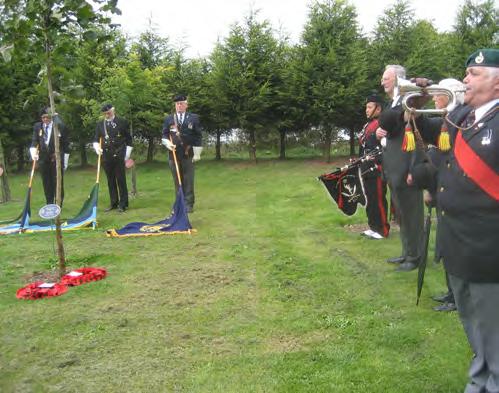
On Sunday those members who were able travelled by car to the National Memorial Arboretum to attend the 1100am Act of Remembrance. At the end Lt Col Pat Soward told the congregation about the ceremony to follow and invited those not in our party to join us if they wished. He explained the
significance of the day, 65 years almost to the day (2 Sep 45) since the signing of the ‘Instrument of Surrender’ aboard the USS Missouri in Tokyo Bay which formally ended the Second World War.
Led by L/Cpl Samir Rai, a piper from 22 Sig Regt, standard bearers carrying the AFSA, Indian Signals Association and Birmingham Branch standards processed to the Far East Air Force Grove where Rev Jim McManus, Chaplain to the AFSA, blessed a tree and dedicated it to all those who had served in 19 (Air Formation) Sig Regt. It appeared that most of those in the chapel had taken up the offer and a goodly number followed to watch. A wreath was laid by Mr Charles Little MBE, who had served in India and Burma with the Regt and after the Exhortation a bugler signalled a silence.
The procession then continued to the Far East area to the tree ‘Planted for all ranks, Royal Signals and Indian Signals, lost in Burma in WW2’ where a new plaque had been installed. The tree was re-dedicated and wreaths laid by Maj Tom Bewsey OBE, chairman of the now disbanded Indian Signals Association, and Lt Col Pat Soward, on behalf of Lt Col Robin Painter in memory of his comrades in the Chindits and at the siege of Imphal who
didn’t return.
After the Exhortation and Kohima Inscription the bugler signalled a further silence after which the parade dismissed. The Indian Signals Association Standard was carried by Mr George Hedge for its last outing before being laid up in the Blandford Garrison Church. George’s father had served in Burma in WW2 and George proudly wore his Burma Star and other medals.
Extracted from: The Wire of Royal Signals

Wednesday, 20 July 2011

IGNOU’s satellite teaching centre for Army Launched in Leh

The Army in alliance with IGNOU today inaugurated a satellite connection with Leh for facilitating distance education to its staff in remote areas, apart from announcing the setting up of an Information Technology Academy together with Microsoft India. Army Chief General V K Singh inaugurated the IGNOU satellite connection with a military base in Leh, thus extending the university’s educational online resources to the army troops set up in the Ladakh region.

This ability, as part of the university and the Army’s combined project Gyandeep, will be simulated soon in other parts of the nation, the Army announced in the occurrence of IGNOU Vice Chancellor Prof Rajashekaran Pillai, Microsoft India chairman and vice president Ravi Venkatesan and Army Western Command chief Lt Gen S R Ghosh.

The IT Academy, which is part of the Army- Microsoft’s ‘Kshamta’ project of the last 1 year under the umbrella of ‘Samarth’ initiatives, would teach Army personnel in IT courses of a variety of levels to authorize them with skills to discover an option post-career retirement.

The flagship plan under ‘Samarth’ is ‘Gyandeep’, which recognizes ‘in service’ training done by soldiers and makes them entitled for the award of guarantee by IGNOU.

Under this plan, over 68,000 soldiers have been registered so far and over 2,300 of them have been awarded diplomas and degrees by now.

‘Kshamta’ was an result of a thoughtful collaboration with Microsoft India aimed at imparting specialized skills like Information Technology and spoken English to soldiers.
IGNOU’s satellite teaching centre for Army Launched in Leh

Gurkha Corps of Signals

31: Gurkha Corps of Signals Badges
History 31: Gurkha Corps of Signals- click here

Royal Corps of Signals (March Past Music)

The Royal Corps of Signals (often simply known as the Royal Signals - abbreviated to R SIGNALS, is one of the combat support arms of the British Army.
The march past music is called, "Begone Dull Care".
Performed by the Band of the Royal Corps of Signals.

Lyrics:
Begone, dull care!
I prithee begone from me;
Begone, dull care!
Thou and I can never agree.
Long while thou hast been tarrying here,
And fain thou wouldst me kill;
But i' faith, dull care,
Thou never shalt have thy will.

Too much care
Will make a young man grey;
Too much care
Will turn an old man to clay.
My wife shall dance, and I shall sing,
So merrily pass the day;
For I hold it is the wisest thing,
To drive dull care away.

Hence, dull care,
I'll none of thy company;
Hence, dull care,
Thou art no pair for me.
We'll hunt the wild boar through the wold,
So merrily pass the day;
And then at night, o'er a cheerful bowl
We'll drive dull care away.

Tuesday, 12 July 2011

Visit to 2 STC

BEVERLY EX BOYS ASSOCIATION
Chairman Mick Teague Secretary Tony Hull as reported in The WIRE

Whilst on holiday in Goa, India, we were travelling back from a visit to a waterfall, when we passed a military establishment and I saw young recruits with a “Jimmy” on their singlets. I made the taxi driver stop so that I could take a photograph of a young recruit.

He stood so proudly to attention for me. He belonged apparently to 3 Trg Regt, Indian Signals, near the city of Margao.
After 2 weeks in South Goa, we moved up to the capital, Panjim. On our journey we passed another building displaying “Jimmies”. I found out that this was 2 Sig Trg Regt, and decided to pay them a visit.
We were taken into a secretary’s office, and explained the reason for our visit. When the Adjt heard that I was an ex-boy, he called us in immediately.
We were given tea and had a long chat with him. He explained that they have a “Raising Day” on 15 February every year and every unit celebrates this. He said the CO would like to meet us and we were taken upstairs, where we were greeted, very cordially, by Brig K A Cariappa and treated with the utmost courtesy.
The first thing that the Brig said to me was that he would like to confiscate my straw hat, which has the Corps colours and the RSA badge. He went on to explain that they have 4,562 recruits in trg. The recruits used to be taken in at sixteen and a half, but the age has been raised to seventeen and a half, due to an international ruling.
The Army is very important in India because of all their borders and they often have to deal with areas of unrest. The Army has over a million soldiers.

Brig Cariappa presents Indian Signals Corps tie to Tony Hull

Brig Cariappa very kindly presented me with their Corps tie and also a copy of The Signalman, their magazine which is equivalent to The Wire.
Extracted from The WIRE of Royal Signals

Wednesday, 6 July 2011

Original Treaty of Surrender is displayed in 2STC

Goa Liberation: Goa publicising wrong Treaty of Surrender doc
PTI, PANAJI | 05 July 2011 13:54 IST


The original historic `treaty of surrender’ signed between Indian Army and Portugal Government while liberating Goa, 50 years back, is not with the state government, who are publicising the `letters during surrender’ as the treaty, historians claimed today.

In what could be startling revelation, the historians, who researched the incidents during December 19, 1961, when Goa was liberated after 450 years of Portuguese rule, have said that the original treaty remains to be out of bound of state government.

Sanjiv Sardesai, a historian, said that the original copy is with the Indian Army’s 2STC office in Panaji displayed on the wall. “What we are showing to the public as treaty of surrender is not the original one,” he said.

He pointed out that state government’s official diary has printed an unsigned letter by then Portuguese Chief Commandant of Armed Forces General Manuel Antonio Vassalo e Silva as the treaty.

The confusion over the treaty continues as another different letter in Portuguese signed by Silva is displayed in the Goa state Museum’s gallery on `Goa Freedom Struggle.’

Sardesai said that the actually original treaty has signatures of Major General K P Candeth, who led Operation Vijay to liberate Goa and Silva, who was commandant of armed forces of states of Portuguese India. “It is in Portuguese and same text is translated in English below it,” he explained.

Another historian, Rohit Falgaonkar, said that `the original copy should have been displayed in the Goa state museum so that the people know about it.’

Falgaonkar said that state government should do activities that would bring people closer to the history of the state.

Director of Goa State Museum, Radha Bhave, said that the copy on display was a facsimile from the book on a freedom struggle, which was put as an exhibit since 2004.

“If there is an original copy available, which is different from that, we will surely try to procure it,” she said.

The confusion about the events preceding Goa’s liberation has also percolated to the students. As per the Secondary School Certification examination book `History of Goa’, the treaty was signed between both the parties below the headlights of car of the Governor.

“The document of surrender was signed at 7.30 p.m. on a street at Vasco-da-Gama under headlights of the Car of Portuguese Governor General and submitted to Brig, K S Dhillon,” the para in the book reads.

Sardesai, pointing out at the original treaty, has said that it was signed in Panaji city and that too at 8.30 p.m.
Goa publicising wrong Treaty of Surrender doc

Comment: The Original Treaty of Surrender needs to find its place in the Corps Museum, before it vanishes

Tuesday, 5 July 2011

US Army Signal Corps Invents Glass Fiber Optics

The Inventors of Glass Fiber Optics at the US Army Signal Corps
The following information was submitted by Richard Sturzebecher, it was originally published in the Army Corp publication "Monmouth Message."
In 1958, at the US Army Signal Corps Labs in Fort Monmouth New Jersey, the Manager of Copper Cable and Wire hated the signal transmission problems caused by lightening and water. He encouraged the Manager of Materials Research, Sam DiVita, to find a replacement for copper wire. Sam thought glass fiber and light signals might work, but the engineers who worked for Sam told him a glass fiber would break! In September 1959, Sam DiVita asked 2nd Lt. Richard Sturzebecher if he knew how to write the formula for a glass fiber capable of transmitting light signals. (Sam had learned that Richard, who was attending the Signal School, had melted 3 triaxial glass systems, using SiO2, for his 1958 senior thesis at Alfred University under Dr. Harold Simpson, Professor of Glass Technology.)

Richard knew the answer. While using a microscope to measuring the index-of-refraction on SiO2 glasses, Richard developed a severe headache. The 60% and 70% SiO2 glass powders under the microscope allowed higher and higher amounts of brilliant, white light to pass through the microscope slide into his eyes. Remembering the headache and the brilliant white light from high SiO2 glass, Richard knew that the formula would be ultra pure SiO2. Richard also knew that Corning made high purity SiO2 powder, by oxidizing pure SiCl4 into SiO2. He suggested that Sam use his power to award a Federal Contract to Corning to develop the fiber.

Sam DiVita had already worked with Corning research people. But he had to make the idea public, because all research laboratories had a right to bid on a Federal contract. So, in 1961 and 1962, the idea of using high purity SiO2 for a glass fiber to transmit light was made public information in a bid solicitation to all research laboratories. As expected, Sam awarded the contract to the Corning Glass Works in Corning, New York in 1962. Federal funding for glass fiber optics at Corning was about $1,000,000 between 1963 and 1970. Signal Corps Federal funding of many research programs on fiber optics until 1985, thereby seeding this industry and making today's multibillion dollar industry that eliminates copper wire in communications a reality.
Today, at age 87, Sam DiVita still comes to work at the US Army Signal Corps every day.
The Inventors of Glass Fiber Optics at the US Army Signal Corps

Monday, 27 June 2011

Snooker orginated in Nerbudda Club Jabalpur

A letter by Compton McKenzie which appeared in the Billiard Player publication of April 1939. The details of the letter have become accepted as fact as to the origins of the game of snooker.

The Billiard Player – April 1939
Last year an article in "The Field" put forward the theory that the game of snooker had its origin at the Royal Military Academy (RMA), Woolwich, where officers of the Royal Artillery and the Royal Engineers receive their training as cadets.

The theory was plausible, because a first-year cadet at "The Shop", as the RMA is familiarly known, is called a "snooker," the soubriquet being time's corruption of the original word for a newly-joined cadet, which was "Neux." It must be remembered that the RMA was founded as long ago as 1741.

The writer of the article stated that the original rules of snooker were copied out by Lord Kitchener from those at "The Shop," brought by him to Ootacamund, India, and there hung up in the Club.

This assertion was formally contradicted by General Sir Ian Hamilton in a letter to "The Field" of July 11, 1938. In point of fact Lord Kitchener never visited India until many years after snooker had become a popular game out there.

Investigation has established that so far from snooker having originated at "The Shop," the game was invented at Jubbulpore in the year 1875 by Colonel Sir Neville Chamberlain, who is fortunately still with us and whose memory is perfectly clear on the subject.

It befell during the "Rains" that Sir Neville, then a young subaltern in the Devonshire Regiment, anxious to vary the game of Black Pool which was being played every long wet afternoon on the Mess billiard table, suggested putting down another coloured ball, to which others of different values were gradually added.

One day a subaltern of the Field Battery at Jubbulpore was being entertained by the Devons, and in the course of conversation told young Chamberlain about the soubriquet "snooker" for first year cadets at Woolwich. To quote Sir Neville's own words: "The term was a new one to me, but I soon had an opportunity of exploiting it when one of our party failed to hole a coloured ball which was close to a corner pocket. I called out to him: 'Why, you're a regular snooker!'

"I had to explain to the company the definition of the word, and, to soothe the feelings of the culprit, I added that we were all, so to speak, snookers at the game, so it would he very appropriate to call the game snooker. The suggestion was adopted with enthusiasm and the game has been called snooker ever since."

In 1876 Sir Neville Chamberlain left the Devons to join the Central-India Horse, taking with him the new game. A year or two later came the Afghan War, a more serious potting game in which young Chamberlain was himself potted.

However, fortunately for himself and the great game which we enjoy so much today, he recovered from his wound, and when at the close of 1881 General Sir Frederick Roberts became Commander-in-Chief of the Madras Army, the inventor of snooker served on his personal staff, and was with Roberts when every summer he moved to the hill station at Ootacamund known to all and sundry as "Ooty"

Here came officers from big garrisons like Bangalore and Secundderabad and planters from Mysore. All of them enjoyed snooker as a speciality of the "Ooty" Club where the rules of the game were drawn up and posted in the billiards room, but not by Lord Kitchener.

During the eighties rumours of the new game in India reached England. One evening Sir Neville Chamberlain when dining in Calcutta with the Maharaja of Cooch Behar was introduced to a well-known professional billiards player whom he had engaged from England for some lessons.

This professional told the Maharaja he had been asked in England to obtain the rules of the new game snooker and the Maharaja introduced Sir Neville Chamberlain to him as the best person to give him the information he wanted because he was the inventor of it.

In a letter to "The Field" of March 19, 1938, Sir Neville regretted he did not know the name of the professional but thought he was probably a contemporary of John Roberts and W. Cook. A week or two later Mr. F. H. Cumberlege wrote to Sir Neville Chamberlain to say that the professional must have been John Roberts himself who came out to Calcutta in 1885. Mr. Cumberlege added that he remembered showing the Maharaja the new game of snooker at Cooch Behar after a shooting party in the spring of 1884.

Sir Neville Chamberlain has received from several other distinguished authorities confirmation of his claim to be the inventor of snooker. Major-General W. A. Watson, Colonel of the Central India Horse (his old regiment) wrote: "I have a clear recollection of you rejoining the regiment in 1884. You brought with you a brand new game, which you called snooker or snookers. There were the black, the pink, the yellow and the green. We all understood it was your own invention. We took to it very keenly."

Major-General Sir John Hanbury Williams (Colonel of the 43rd Oxfordshire and Buckinghamshire Light Infantry) wrote: "I was always under the impression that you introduced the game of snooker to the 43rd. in 1884-5. Certainly the 43rd never played snooker till you came and introduced it to us. Hope you will stick to the honour of its invention."

Field Marshal Lord Birdwood wrote: "I remember well you introducing the game of snookers into the 12th Lancers' Mess, when I was a subaltern in the Regiment at Bangalore in '85."

Sir Walter Lawrence, Bt., wrote: "When we first met in Simla in 1886, when you were with Lord Roberts, the Commander-in-Chief, and afterwards when we served together in Kashmir, I always looked upon you as the inventor of snooker, and I know that this idea was common to many of my friends. Quite recently, last year (1937) I was telling some of my friends in England who were discussing snooker, that I had the honour of knowing very intimately the inventor of the game."

The testimony of these and other highly distinguished officers finally disposes of the theory advanced with some emphasis by the writer in "The Field" that the game of snooker originated at the Royal Military Academy, Woolwich, and it has been a privilege for me to assemble in print such incontrovertible evidence.

There is nothing to add except that all the many thousands of snooker players the world over will wish Colonel Sir Neville Chamberlain, who is now in his 84th year, many another year to enjoy the honour of being the inventor of a game, now 63 years old, which has added so much to the gaiety of nations.
– Compton McKenzie. (1938)
Click here to read the original article